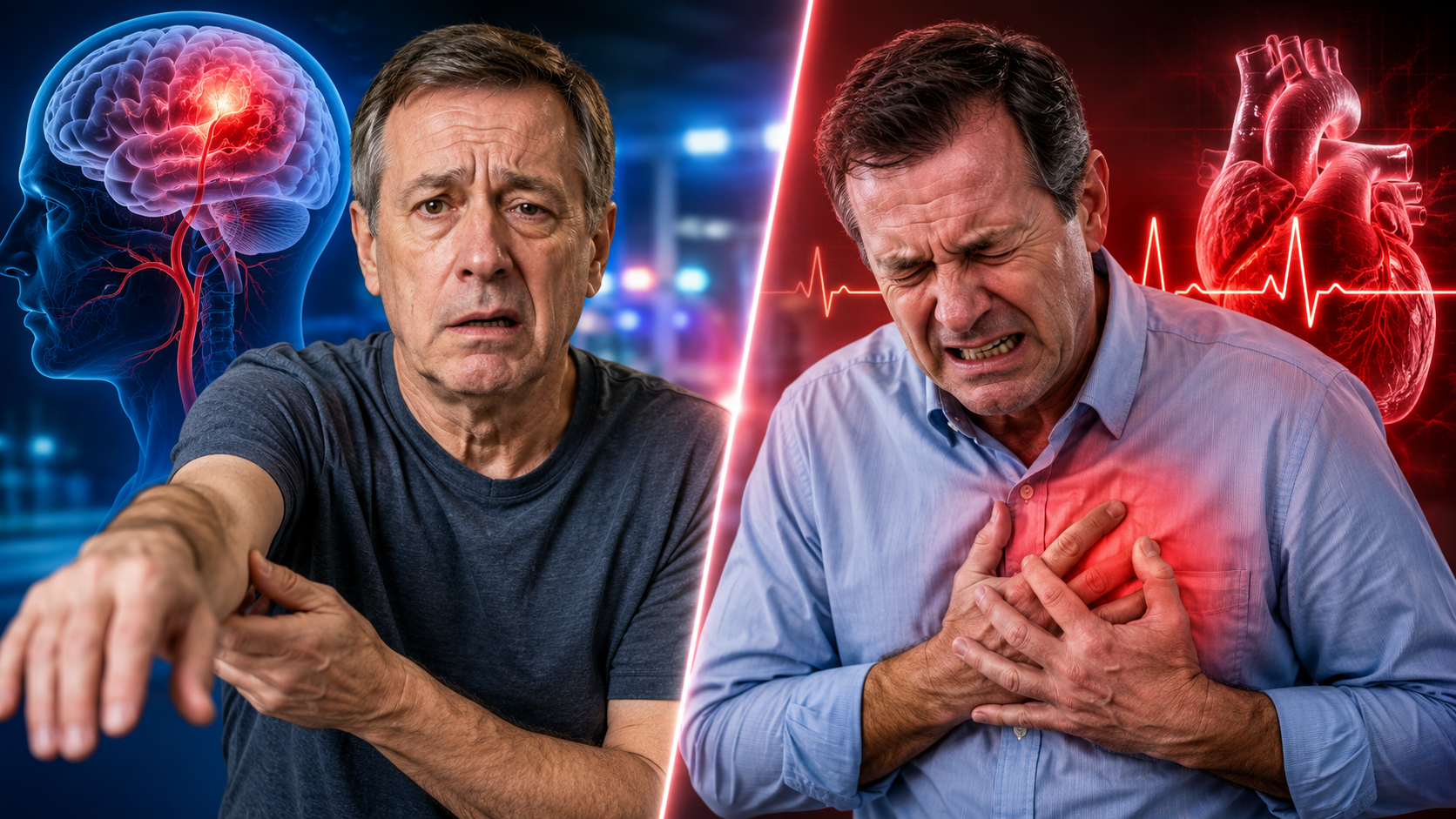
Every 40 seconds, someone in the United States has a stroke. With that same frequency, someone else is having a heart attack. According to NurseRegistry’s analysis of CDC data, these two statistics reveal a sobering reality: both conditions are common enough that almost everyone will eventually witness one in a family member, friend, or stranger, and knowing how to tell them apart in the moment is not just helpful information but potentially lifesaving knowledge.
The Core Difference: Which Organ Loses Blood Flow
A Heart Attack Blocks Blood Flow to the Heart
According to Medanta’s clinical overview, a heart attack occurs when blood flow to part of the heart muscle gets blocked, typically by a blood clot in a coronary artery that stops oxygen from reaching heart tissue, with heart cells beginning to die within minutes without that oxygen supply. Plaque buildup in the arteries over time, a process known as atherosclerosis, leads to the coronary artery disease responsible for most heart attacks, according to a comparison from Solace, which describes how a sticky mix of cholesterol, fat, and cellular waste lines coronary artery walls over time, and when one of these plaques ruptures, a clot can form and completely block blood flow, triggering the heart attack itself.
A Stroke Blocks or Bleeds Into the Brain
According to Medanta, the brain loses its blood supply during a stroke from either a blockage, called an ischemic stroke, or bleeding, called a hemorrhagic stroke, with clots blocking brain arteries responsible for 87 percent of strokes and blood vessel ruptures accounting for the remaining 13 percent as hemorrhagic events. According to Mass General Brigham, a stroke is an emergency condition that occurs when blood flow to the brain suddenly changes, and this loss of oxygen causes brain cells to begin dying very quickly, generally even faster than heart cells do during a heart attack.
Recognizing the Symptoms of Each
The FAST Method for Stroke Recognition
According to Cardiovascular Group’s guide, common stroke symptoms include sudden weakness or numbness, especially on one side of the body, difficulty speaking, confusion, facial drooping, vision changes, trouble walking, and a severe headache that appears without warning. The medical community teaches a simple acronym to help anyone recognize these signs quickly under pressure. According to Federa’s emergency guide, FAST stands for Face, asking the person to smile and checking whether one side droops; Arms, asking them to raise both arms and checking whether one drifts downward; Speech, asking them to repeat a simple phrase and checking for slurring; and Time, meaning that if any of these signs are present, it is time to call 911 immediately.
Heart Attack Symptoms Center on Chest Discomfort
According to Federa, heart attack warning signs are less about sudden paralysis and more about intense, crushing discomfort, often described as an “elephant on the chest” sensation. If someone is clutching their chest, struggling to catch their breath, and complaining of pain shooting up their jaw or down their left arm, this should be treated as a cardiac emergency immediately. According to Apollo247’s comparison guide, anyone experiencing chest pain, shortness of breath, or radiating pain in the arm or jaw lasting longer than five minutes should seek immediate medical attention.
A Genuine Warning Sign Worth Understanding: The Mini-Stroke
What a TIA Actually Is
According to MedicineNet’s clinical overview, a transient ischemic attack, or TIA, sometimes called a mini-stroke, occurs when there is a temporary blockage of a blood vessel in the brain, producing symptoms similar to a full stroke that resolve completely within a short period once the clot blocking the vessel breaks apart, meaning it does not produce any permanent damage or lasting effects on its own.
Why a TIA Should Never Be Ignored
Federa’s emergency physician reporting is direct on this point: a mini stroke is a glaring clinical red flag that a major, permanent stroke is imminent, often within 48 hours of the initial warning episode. This makes a TIA one of the most important, and most commonly dismissed, warning signs in emergency medicine, precisely because its symptoms resolve on their own and can lull someone into believing nothing serious has happened.
The Heart’s Closest Equivalent
Federa notes that comparing a mini-stroke to a heart attack equivalent is genuinely difficult, but the closest parallel would be unstable angina, temporary chest pain that goes away with rest, both representing critical warning signs that a much larger cardiovascular event may follow shortly afterward if the underlying cause is not addressed urgently.
Two Distinct Types of Stroke Worth Understanding Separately
Ischemic Stroke, the More Common Type
Since clots account for the majority of strokes, understanding this mechanism specifically matters for prevention and treatment. Solace describes an ischemic stroke as occurring when a brain clot blocks blood flow to brain tissue, a mechanism analogous in some ways to how a coronary clot causes a heart attack, though occurring in a different vascular system entirely.
Hemorrhagic Stroke, Less Common but Often More Severe
According to Cardiovascular Group, a hemorrhagic stroke happens when a blood vessel in the brain bursts and leaks blood into the surrounding tissue, increasing pressure inside the skull and damaging brain cells, with the most common causes including high blood pressure, aneurysm rupture, or weakened vessel walls. Symptoms can include a sudden, severe headache, confusion, difficulty walking, or speech difficulties, and these symptoms often develop faster and more severely than in an ischemic stroke, with some people losing consciousness or experiencing vision changes. Treatment for hemorrhagic stroke focuses specifically on controlling the bleeding and reducing pressure within the brain, sometimes requiring surgery to repair the damaged vessel or remove pooled blood.
Why Speed of Response Matters So Much for Both Conditions
Treatment Windows Are Measured in Hours, Not Days
According to NurseRegistry, stroke medications work best within 3 to 4.5 hours of symptom onset, while heart attack procedures achieve optimal results within 90 minutes of hospital arrival, and every minute of delayed treatment destroys more brain or heart tissue in either case. This is precisely why Federa’s guidance frames the question of which condition is “worse” as genuinely dependent on the speed of emergency response rather than one condition being inherently more dangerous than the other.
Always Call Emergency Services Rather Than Self-Transport
According to Medanta, anyone suspecting either a stroke or heart attack should call the emergency number right away rather than attempting to drive themselves or the affected person to the hospital, since emergency responders can begin critical treatment and monitoring during transport, and a medical emergency occurring while driving poses an obvious additional danger.
A Key Difference in Immediate First-Aid Response
According to NurseRegistry, heart attack victims should chew aspirin unless they have a known allergy, while suspected stroke cases require the FAST test rather than any medication administration, a genuinely important distinction since taking aspirin during a hemorrhagic stroke could worsen bleeding, reinforcing why accurately identifying which emergency is occurring matters even in the earliest moments of response.
Shared Risk Factors, Different Underlying Mechanisms
The Overlapping List of Risk Factors
According to Mass General Brigham, stroke and heart attack are emergency conditions that may appear similar at first and even share some of the same risk factors, including high blood pressure, high cholesterol, smoking, diabetes, obesity, and a sedentary lifestyle. Solace confirms that these shared risk factors raise risk for both conditions even though they affect the body through different, organ-specific mechanisms, underscoring why comprehensive cardiovascular risk management protects against both simultaneously rather than requiring entirely separate prevention strategies.
Sudden Cardiac Arrest Is a Separate, Related Emergency
Solace notes an important related distinction worth knowing: an electrical issue in the heart can cause arrhythmias, or irregular heartbeats, which may lead to sudden cardiac arrest, a genuinely distinct emergency from both a heart attack and a stroke, though one that shares some overlapping risk factors and can sometimes occur as a complication of an underlying heart attack itself.
Building a Prevention Strategy That Protects Against Both
Addressing Shared Cardiovascular Risk Factors
Naturem’s comprehensive guide to heart attack prevention and risk factors explains that sustained high blood pressure creates microscopic arterial damage that accelerates atherosclerosis, the same underlying process responsible for both coronary artery blockages leading to heart attacks and, in many cases, the arterial narrowing that contributes to ischemic strokes, making blood pressure management a genuinely dual-purpose protective strategy.
A Heart- and Brain-Healthy Dietary Foundation
Naturem’s comparison of the DASH and Mediterranean diets offers an evidence-based dietary framework specifically designed to support healthy blood pressure and lipid profiles, both directly relevant to reducing risk for stroke and heart attack simultaneously given how heavily these two conditions share underlying cardiovascular risk factors.
Supporting Circulatory Health More Broadly
Naturem’s overview of oxidative stress and cellular aging explains how oxidative damage contributes to the atherosclerotic process affecting arteries throughout the body, reinforcing why an antioxidant-rich, anti-inflammatory dietary pattern supports vascular health broadly, rather than protecting only the heart or only the brain in isolation.
A Practical Emergency Response Checklist
- Use the FAST method for suspected stroke: check for Face drooping, Arm weakness, Speech difficulty, and note the Time symptoms began before calling 911
- Watch for crushing chest pain, shortness of breath, and pain radiating to the jaw or left arm lasting more than five minutes as signs of a probable heart attack
- Call emergency services immediately for either condition rather than attempting to drive yourself or the affected person to the hospital
- Never ignore a mini-stroke or episode of unstable angina, since both can signal a major, permanent event is imminent within the following hours or days
- Remember that heart attack victims should chew aspirin unless allergic, while suspected stroke victims should not be given aspirin or other medication before emergency evaluation
- Know that treatment windows are narrow, with stroke medications most effective within 3 to 4.5 hours and heart attack procedures achieving best outcomes within 90 minutes of hospital arrival
- Address shared risk factors, including blood pressure, cholesterol, blood sugar, smoking, and sedentary lifestyle, as part of a comprehensive strategy protecting against both conditions at once
Conclusion
A stroke and a heart attack are both sudden, life-threatening interruptions of blood flow, but they strike different organs through distinct mechanisms, present with genuinely different symptom patterns, and require different immediate first-aid responses even as they share many of the same underlying cardiovascular risk factors. The FAST method offers a fast, memorable way to recognize stroke symptoms, while crushing chest pain radiating to the jaw or arm should always prompt immediate concern for a heart attack. In either case, the single most important action is the same: call emergency services immediately rather than waiting to see if symptoms improve, since the treatment windows for both conditions are measured in hours, and every minute of delay allows more permanent damage to occur.
Frequently Asked Questions
According to CDC data, someone in the United States experiences a stroke every 40 seconds, and with that same frequency, another person suffers a heart attack, making both conditions common enough that most people will eventually encounter one in someone they know. (NurseRegistry, 2026)
FAST stands for Face (checking for one-sided drooping when smiling), Arms (checking whether one arm drifts downward when raised), Speech (checking for slurred speech when repeating a phrase), and Time (calling 911 immediately if any of these signs are present). (Federa, 2026)
Yes, generally, unless they have a known aspirin allergy, while suspected stroke victims should not be given aspirin or other medication before emergency evaluation, since aspirin could worsen bleeding in a hemorrhagic stroke. (NurseRegistry, 2026)
A transient ischemic attack, or TIA, produces stroke-like symptoms that resolve completely within a short period, but it is considered a major warning sign that a full, permanent stroke may occur soon afterward, often within 48 hours, making it something that should never be ignored despite its temporary nature. (Federa, 2026)
Stroke medications work best within 3 to 4.5 hours of symptom onset, while heart attack procedures achieve optimal results within 90 minutes of hospital arrival, with every minute of delay allowing more permanent damage to brain or heart tissue. (NurseRegistry, 2026)
References:
Apollo247. (n.d.). Difference between heart attack and stroke. https://www.apollo247.com/health-topics/heart-attack/difference-between-heart-attack-and-stroke
Cardiovascular Group. (2026, March 11). Stroke vs heart attack: Key differences, symptoms & emergency response. https://cvgcares.com/stroke-vs-heart-attack-understanding-the-critical-differences/
Federa. (2026, April 23). Stroke vs heart attack: Key differences, symptoms, and what’s more dangerous (2026 guide). https://www.federa.org/conditions/heart-health/stroke-vs-heart-attack/
Mass General Brigham. (2026, April 30). Stroke vs. heart attack: Spot the difference and get help. https://www.massgeneralbrigham.org/en/about/newsroom/articles/stroke-vs-heart-attack
Medanta. (2026, May 13). Heart attack vs stroke: Critical signs you can’t afford to miss. https://www.medanta.org/patient-education-blog/heart-attack-vs-stroke-critical-signs-you-cant-afford-to-miss
MedicineNet. (2025, January 17). Stroke vs heart attack: Symptoms, treatment & prevention. https://www.medicinenet.com/heart_attack_vs_stroke_brain_attack/article.htm
Naturem.us. (2025, November 3). Oxidative stress: The hidden mechanism behind aging and chronic disease. https://naturem.us/blogs/sharper-memory/oxidative-stress-chronic-diseases
Naturem.us. (2026, February 27). Prevention and risk factors for heart attack: A comprehensive guide. https://naturem.us/blogs/healthy-advice/prevention-and-risk-factors-for-heart-attack-a-comprehensive-guide
Naturem.us. (2026, March 5). DASH diet vs. Mediterranean diet: Which is better? https://naturem.us/blogs/steady-glucose/dash-diet-vs-mediterranean-diet-which-is-better
NurseRegistry. (2026, March 24). What is the difference between a stroke and a heart attack. https://www.nurseregistry.com/blog/what-is-the-difference-between-a-stroke-and-a-heart-attack/
Solace. (n.d.). Stroke vs heart attack: How to tell the difference. https://www.solace.health/articles/stroke-vs-heart-attack-differences