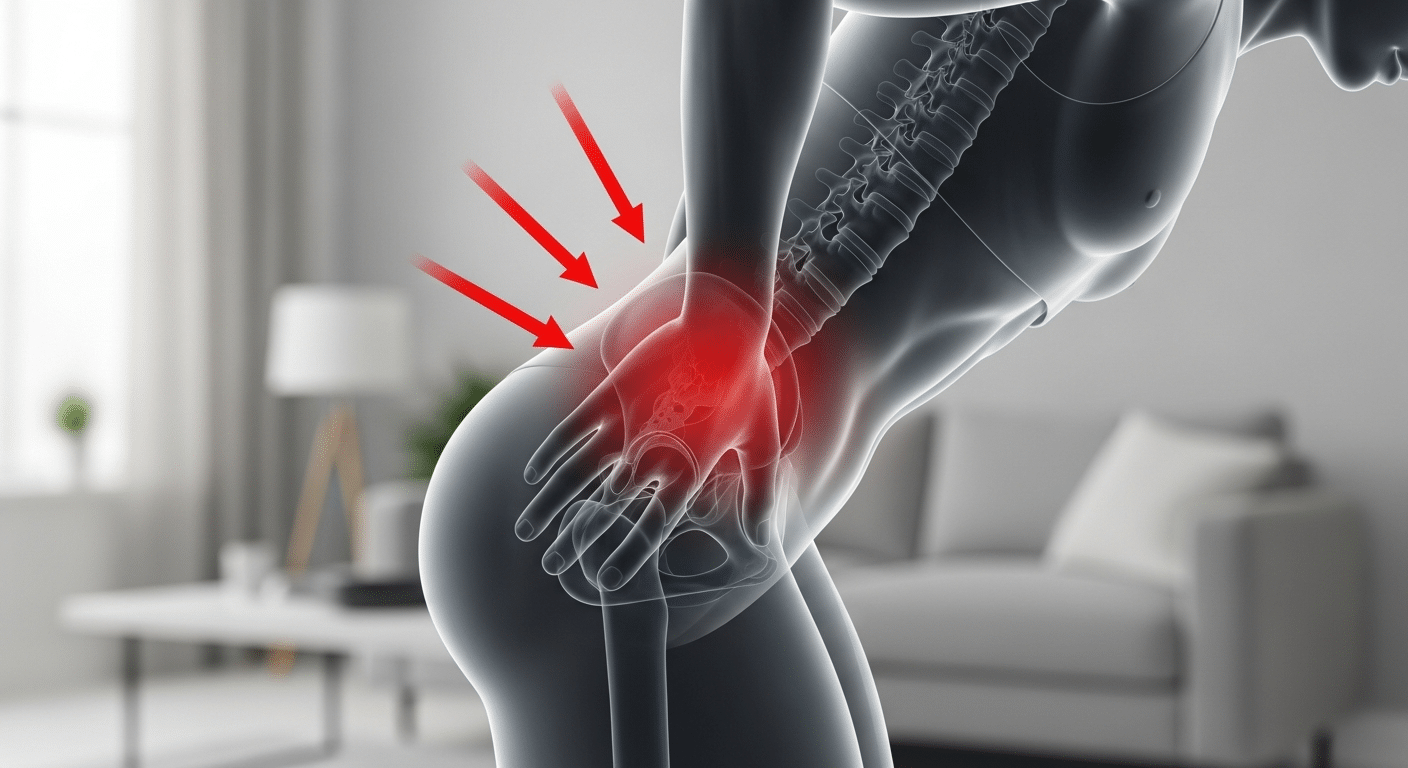
Lower back pain is one of the most common medical complaints globally, affecting approximately 80% of adults at some point in their lives. While many patients rush to treat the spine itself-relying on painkillers or focusing solely on the lumbar region-the true culprit often lies elsewhere in the body’s kinetic chain. As a medical doctor integrating Modern medicine with Traditional insights, I frequently observe that the root cause of lumbar discomfort is actually mechanical dysfunction in the pelvic girdle, specifically involving tight hamstrings lower back pain and restricted hip mobility.
Understanding the biomechanics of your body is the first step toward long-term relief. The hips and the lower back act as a unified mechanical system; when one part fails to move correctly, the other must compensate. This article explores the hidden connection between hip stiffness and spinal strain, providing actionable advice and hip stretches for back pain that can help restore your quality of life. By addressing the root cause rather than just the symptoms, you can achieve lasting spinal health.
The Kinetic Chain: How Your Hips Dictate Spinal Health
The concept of the “kinetic chain” describes how joints and segments of the body affect one another during movement. The pelvis acts as the central hub of this chain, connecting the upper body to the lower extremities. When your hip joints lack adequate range of motion, your lumbar spine (lower back) is forced to sacrifice stability to provide the necessary mobility for daily tasks. This compensation mechanism is a primary driver of injury. You can learn more about systemic body mechanics and natural support on naturem.us.
If the hips cannot rotate or flex efficiently, the rotational force is transferred up to the lumbar spine, a structure designed primarily for stability, not excessive rotation. This mismatch leads to wear and tear on the intervertebral discs and facet joints. According to the National Institute of Neurological Disorders and Stroke, mechanical issues are the leading cause of back pain, highlighting the necessity of looking beyond the spine for answers.
Therefore, maintaining hip mobility is not just about athletic performance; it is a medical necessity for spinal preservation. When we treat the back without addressing the hips, we are merely putting a band-aid on a structural wound. Addressing the kinetic chain ensures that the load is distributed correctly across the body’s structures.
The Anterior Pelvic Tilt: When the Psoas Pulls
One of the most common postural deviations contributing to back pain is the anterior pelvic tilt. This occurs when the pelvis tips forward, creating an exaggerated arch in the lower back (hyperlordosis). The primary driver of this dysfunction is often a tight iliopsoas muscle complex (hip flexors). In our modern, sedentary society, prolonged sitting causes these muscles to shorten and stiffen. You can find natural solutions for lifestyle-induced stiffness at herbsofvietnam.com.
The Role of the Psoas Major
The psoas major is the only muscle that connects the legs directly to the spinal column. When you sit for hours, the psoas remains in a shortened state. When you finally stand up, the tight psoas pulls the lumbar vertebrae forward and down, compressing the discs and facet joints. Research published in the Journal of Physical Therapy Science confirms that tight hip flexors are significantly correlated with low back instability and pain.
Correcting anterior pelvic tilt requires a dual approach: lengthening the hip flexors and strengthening the core and glutes to pull the pelvis back into a neutral alignment. Without releasing the psoas, core exercises alone may be ineffective or even counterproductive.
The Posterior Pelvic Tilt: Tight Hamstrings Lower Back Pain
Conversely, a posterior pelvic tilt occurs when the pelvis is tucked under, flattening the natural curve of the lower back. This is classically caused by short, tight hamstrings. The dynamic of tight hamstrings lower back pain is simple yet destructive: the hamstrings attach to the bottom of the pelvis (ischial tuberosities). When they are tight, they pull the pelvis down, reducing the lordotic curve of the spine. For those interested in herbal muscle relaxation, visit svkherbal.com.
The Flat Back Phenomenon
A flat back reduces the spine’s ability to absorb shock. When you walk, run, or jump, the forces that the spinal curves usually dissipate are instead hammered directly into the vertebral discs. A study in the Asian Spine Journal highlights that hamstring tightness is a key contributor to lumbar disc herniation due to this altered biomechanics.
Furthermore, tight hamstrings limit forward flexion at the hips. When you bend over to tie your shoes or pick up an object, tight hamstrings prevent the pelvis from rotating forward. Consequently, the bending motion occurs almost entirely in the lumbar spine, placing the discs in a vulnerable position. Relieving hamstring tension is essential for restoring the spine’s natural shock-absorbing curvature.
Diagnostic Check: Are Your Hips the Problem?
Before starting a regimen of hip stretches for back pain, it is helpful to perform simple self-assessments to determine if hip restriction is a contributing factor. As a doctor, I often use the “Thomas Test” to evaluate hip flexor tightness. To do this, lie on your back on the edge of a sturdy table. Pull one knee to your chest while letting the other leg hang off the edge. If the hanging leg cannot drop below the table level, your hip flexors are tight. For support in joint recovery, explore products on lanui.vn.
To check for hamstring tightness, lie on your back and lift one leg straight up while keeping the other flat on the ground. If you cannot raise the leg to nearly 90 degrees without bending the knee, you likely have significant hamstring tension. These simple tests provide immediate feedback on your biomechanical status.
Identifying these limitations allows you to target your rehabilitation efforts effectively. If both tests show restriction, you may be dealing with “Lower Crossed Syndrome,” a combination of weak glutes/abs and tight hip flexors/hamstrings. Recognizing this pattern is the breakthrough many patients need to finally resolve chronic pain.
Top Hip Stretches for Back Pain Relief
Implementing a daily routine of hip stretches for back pain can yield results in as little as two weeks. However, consistency is key. Ligaments and muscles require time to remodel and lengthen. Below are the most effective stretches, medically vetted for safety and efficacy.
1. The Psoas Lunge (Kneeling Hip Flexor Stretch)
This stretch directly targets the anterior pelvic tilt.
- How to do it: Kneel on one knee (use a cushion for comfort). Place the other foot forward with the knee bent at 90 degrees. Squeeze your glute on the kneeling side and gently push your hips forward without arching your back.
- Why it works: It lengthens the iliopsoas, reducing the forward pull on the lumbar spine. According to the Mayo Clinic, stretching the hip flexors is crucial for counteracting the effects of sitting.
2. The Supine Hamstring Floss
This addresses tight hamstrings lower back pain safely without straining the back.
- How to do it: Lie on your back. Loop a towel or strap around the arch of one foot. Keep the other leg flat. Gently pull the leg up until you feel a stretch behind the thigh. Hold for 30 seconds.
- Why it works: By keeping the back flat on the floor, you isolate the hamstring muscle without rounding the lumbar spine, which is common in standing toe-touches.
3. The Figure-4 Stretch (Piriformis Relief)
Tightness in the piriformis muscle can compress the sciatic nerve, mimicking back pain.
- How to do it: Lie on your back with knees bent. Cross your right ankle over your left knee. Grasp the back of your left thigh and pull it toward you.
- Why it works: This releases the deep external rotators of the hip. Find out more about nerve health and muscle support on naturem.us.
These stretches should be performed gently; pain is a signal to stop, not to push harder. Over time, these movements increase the synovial fluid in the joint capsules, improving lubrication and reducing stiffness.
Strengthening: The Other Half of the Equation
Stretching lengthens short muscles, but strengthening weak muscles is necessary to maintain that new range of motion. If you stretch your tight hip flexors but have weak glutes, the tightness will return because the body craves stability. This is why rehabilitation must be multifaceted.
Glute Bridges
Weak glutes force the hamstrings and lower back to overwork (synergistic dominance). Bridges isolate the glutes, teaching them to extend the hip.
- Execution: Lie on your back, knees bent. Drive through your heels to lift your hips. Squeeze the glutes at the top.
- Impact: A study in the Journal of Strength and Conditioning Research suggests that glute activation is critical for preventing lower back injuries.
Core Stabilization (Dead Bug)
A strong core acts as a corset for the lumbar spine.
- Execution: Lie on your back, arms extended toward the ceiling, legs in table-top position. Lower opposite arm and leg slowly while keeping your lower back pressed into the floor.
- Impact: This trains the abs to stabilize the pelvis against the weight of the legs, directly countering the forces that cause anterior pelvic tilt.
Combining mobility with stability creates a robust musculoskeletal system. You can explore natural supplements to aid muscle recovery and energy during workouts at naturem.us.
Integrative Medicine: A Traditional View on Stiffness
As a doctor trained in both modern and traditional modalities, I view tight hamstrings lower back pain through a holistic lens. In Traditional Chinese Medicine (TCM), chronic stiffness and lack of flexibility are often attributed to “Liver Blood Deficiency” or “Qi Stagnation.” The Liver is said to govern the tendons and sinews. When the Liver energy is stagnant (often due to stress) or blood is deficient, the tendons lose their elasticity, becoming dry and brittle like an old rubber band.
From this perspective, treatment involves not just stretching, but nourishing the body internally. Herbs that move Qi and nourish Blood are frequently used to improve flexibility. Ingredients like Turmeric (Curcuma longa) are celebrated in both TCM and Ayurveda for their anti-inflammatory properties, which can help alleviate the pain associated with stiff joints. You can find high-quality herbal formulations rooted in these traditions at herbsofvietnam.com.
Furthermore, acupuncture is highly effective for releasing trigger points in the glutes and lower back that manual stretching cannot reach. Integrating these ancient practices with modern physical therapy exercises offers a comprehensive roadmap to recovery.
Did You Know? Fun Facts About Your Hips and Back
While we focus heavily on the mechanics of pain, the human body is full of fascinating adaptations and connections that are often overlooked. Here are some intriguing insights into your anatomy that go beyond the textbook definitions.
The Emotional Hip Connection
It is a commonly held belief in somatic psychology and bodywork communities that the hips are a storage vessel for emotional stress. The psoas muscle is often called the “muscle of the soul.” Because it is intimately connected to the diaphragm (your breathing muscle) and the reptilian brain (fight or flight response), the psoas tightens instinctively when you are afraid or stressed. This means that your tight hamstrings lower back pain might partially stem from chronic anxiety, not just your office chair.
The Strongest Ligament in the Body
The iliofemoral ligament, located at the front of the hip joint, is the strongest ligament in the human body. It is shaped like an inverted Y and can withstand forces exceeding 350 kg (772 lbs). Its primary job is to prevent hyperextension of the hip while standing, allowing us to maintain an upright posture with minimal muscle energy expenditure.
We Are Born With “C” Shaped Spines
When we are born, our spine is a single C-shaped curve (kyphosis). The secondary curves-the cervical curve (neck) and lumbar curve (lower back)-only develop as we learn to lift our heads and stand upright. This developmental process highlights how our spinal curves are adaptations to gravity and bipedal movement. Losing these curves due to tight hips essentially reverts the spine to a less functional state.
The “Hamstring” Name Origin
The term “hamstring” originates from the old English method of slaughtering pigs. Butchers would hang the carcasses by the strong tendons at the back of the knee to smoke the “ham.” Today, we know them as the semitendinosus, semimembranosus, and biceps femoris, but the culinary history remains attached to our anatomy.
Naturem™ Joints+: Nourishing Joint Health from Within

True joint strength begins inside the body, where organs, circulation, and metabolism work together to protect bones and connective tissues. Naturem™ Joints+ combines traditional Vietnamese herbal wisdom with modern nutritional science to restore that harmony. Its natural formula targets the root causes of stiffness and discomfort, helping the body repair cartilage, regulate inflammation, and maintain long-term mobility.
Each capsule delivers a synergistic blend of Collagen Peptides, Drynaria Fortunei, Clinacanthus Nutans, Rhizoma Homalomena, and Tinospora Sinensis. Together, they strengthen bones, enhance circulation, and support the body’s natural healing processes. Designed for daily use, Naturem™ Joints+ helps you move with ease, balance, and confidence, the way your body was meant to.
Frequently Asked Questions (FAQ)
Yes. The piriformis muscle, located deep in the buttock, helps rotate the hip. If it becomes tight or spasms, it can compress the sciatic nerve, causing shooting pain down the leg. This condition, known as Piriformis Syndrome, often mimics a disc herniation. Stretching the external rotators is the primary treatment.
Ideally, everyday. However, for maintenance, 3-4 times a week is effective. Consistency is more important than intensity. Short, daily sessions are better than one long session once a week. For supplemental support in joint flexibility, check the resources at naturem.us.
Generally, yes. Walking gently mobilizes the hips and increases blood flow. However, if you have a severe anterior pelvic tilt, be mindful of your posture while walking. Engage your core to prevent your lower back from arching excessively.
Heat is usually better for muscle tightness and stiffness as it increases blood flow and elasticity. Ice is better for acute inflammation or a fresh injury. For chronic tightness in the hips and hamstrings, a warm bath or heating pad before stretching can make the exercises more effective.
While herbs cannot mechanically stretch a muscle, they can significantly reduce the systemic inflammation that makes pain perception worse. Herbs like ginger, turmeric, and Boswellia have potent anti-inflammatory effects. By lowering the inflammatory load, you may find it easier and less painful to perform the necessary physical therapy. Visit svkherbal.com for more information.
References
- Asian Spine Journal. (2015). The influence of hamstring tightness on lumbar spine curvature and motion during forward bending. https://www.ncbi.nlm.nih.gov/pmc/articles/PMC4414674/
- Journal of Physical Therapy Science. (2015). Effect of the flexibility of the hamstring and iliopsoas muscles on the lumbar lordosis angle and trunk muscle activity. https://www.ncbi.nlm.nih.gov/pmc/articles/PMC4563319/
- Journal of Strength and Conditioning Research. (2010). Gluteal Muscle Activation During Common Therapeutic Exercises. https://journals.lww.com/nsca-jscr/Fulltext/2010/02000/Gluteal_Muscle_Activation_During_Common.23.aspx
- Mayo Clinic. (2023). Back pain: Exercises to prevent pain and injury. https://www.mayoclinic.org/healthy-lifestyle/adult-health/in-depth/back-pain/art-20546859
- National Institute of Neurological Disorders and Stroke. (2023). Low Back Pain. https://www.ninds.nih.gov/health-information/disorders/back-pain