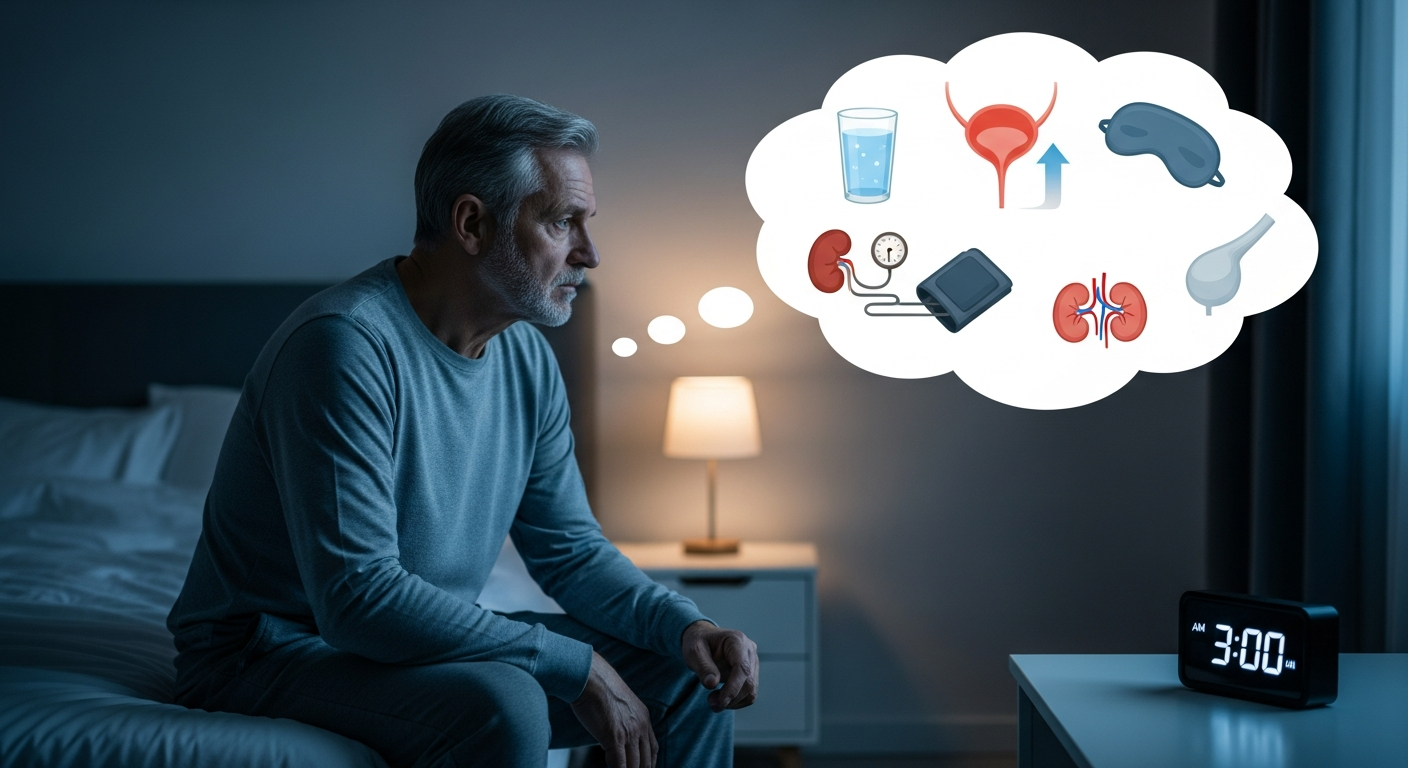
The Hidden Burden of Nocturia and Why It Matters
Nocturia, the need to wake during the night to urinate, is more than a minor inconvenience. It is among the most common lower urinary tract symptoms (LUTS) and can significantly impair sleep quality, daily functioning, and overall quality of life.
Its prevalence increases with age, affecting both men and women, and is closely linked to hormonal fluctuations, cardiovascular status, and bladder function. Understanding the underlying cause, whether hormonal, renal, neurological, or lifestyle-related, is critical for effective treatment and long-term relief.
Read more articles: Nocturia – Causes, Symptoms, and Natural Treatments for Better Sleep
Four Major Clinical Causes of Nocturia
Clinically, nocturia is classified into four main categories, based on the mechanism responsible for nighttime urination (Weiss, 2006):
- Nocturnal polyuria (excess urine production at night)
- Global polyuria (increased total 24-hour urine volume)
- Bladder storage dysfunction (reduced capacity or overactivity)
- Sleep disorders (fragmented sleep with bladder awareness)
Nocturnal Polyuri
Nocturnal polyuria (NP) occurs when nighttime urine production exceeds 20% of total 24-hour volume in young adults, or 33% in older adults. It is the most common cause of nocturia in the elderly.
This condition is often linked to:
- Reduced secretion of antidiuretic hormone (ADH) during sleep
- Congestive heart failure and fluid redistribution
- High salt intake or late-evening fluid consumption
Studies show that aging reduces the nocturnal rise in ADH levels, leading to increased urine production during sleep (Johns Hopkins Medicine).
Global Polyuria
Global polyuria refers to an overall increase in 24-hour urine output, commonly exceeding 3 liters per day.
Key causes include:
- Uncontrolled diabetes mellitus, due to osmotic diuresis from hyperglycemia
- Diabetes insipidus, which impairs vasopressin regulation
- Excessive fluid intake, including in psychogenic polydipsia
This condition can be diagnosed through urine output measurement and underlying metabolic evaluation (NIDDK).
Bladder Storage Dysfunction
In this category, nocturia arises from a bladder unable to hold normal volumes of urine, often due to:
- Overactive bladder (OAB) with involuntary contractions
- Bladder outlet obstruction (e.g., from benign prostatic hyperplasia)
- Chronic bladder inflammation or neurological disorders (e.g., Parkinson’s, multiple sclerosis)
These conditions lead to reduced functional bladder capacity, resulting in increased voiding frequency, especially at night (Andersson, 2002).
Sleep Disorder
Sleep fragmentation caused by insomnia, obstructive sleep apnea (OSA), or restless leg syndrome can increase nighttime awakenings. During these arousals, even a partially filled bladder may prompt urination – not due to overproduction but increased bladder awareness.
Research shows a strong bidirectional link between poor sleep and nocturia, particularly in older adults (NIH – NHLBI).
Summary Table
| Cause | Key Mechanism | Common Triggers |
| Nocturnal Polyuria | Excess urine at night | ↓ ADH, aging, CHF, high salt/fluid intake |
| Global Polyuria | Increased total 24h urine volume | Diabetes mellitus, diabetes insipidus, polydipsia |
| Bladder Dysfunction | Reduced bladder capacity | OAB, obstruction, inflammation, neuro disorders |
| Sleep Disorders | Nighttime arousals increase urination | OSA, insomnia, sleep fragmentation |
Hormonal Imbalance and Its Role
Hormonal shifts affect both urine production and bladder control:
- ADH secretion diminishes with age, reducing urine concentration at night and leading to increased nocturnal output.
- Low testosterone in men is associated with increased nocturia and lower urinary tract symptoms.
- Postmenopausal estrogen deficiency weakens the bladder lining and reduces urethral support, contributing to urgency and frequency during the night.
Gender-Specific Causes
While nocturia can affect anyone, certain causes are more prevalent in one gender due to anatomical and hormonal differences.
In Men: Prostate Enlargement (Benign Prostatic Hyperplasia)
Benign prostatic hyperplasia (BPH) is one of the leading causes of nocturia in older men. It affects about 50% of men by age 60 and up to 90% by age 85, leading to urinary frequency, incomplete emptying, and nocturnal urination (NIDDK, 2023).
The enlarged prostate gland compresses the urethra, obstructs bladder emptying, and causes residual urine accumulation-triggering frequent urges to void at night.
Management options include:
- Lifestyle changes: limiting evening fluid intake, adjusting sleep posture
- Medications: alpha-blockers (e.g., tamsulosin) or 5-alpha-reductase inhibitors
- Surgical interventions: such as TURP, in cases of severe obstruction

TURP for an enlarged prostate, source: urologycare
In Women: Pelvic Floor Dysfunction and Hormonal Changes
In women, pelvic floor dysfunction is a major, but often underdiagnosed, contributor to nocturia. Causes include:
- Vaginal childbirth, which stretches pelvic ligaments and muscles
- Menopause-related estrogen decline, which affects urethral tone
- Aging, leading to weakened bladder support
These factors can result in bladder prolapse (cystocele) or reduced bladder control, increasing both daytime and nighttime urination.

Rectocele Diagram Courtesy of Robin Noel, Hospital of the University of Pennsylvania Department of Surgery
4th Floor Maloney Building, Fitts Education Center
Treatment may include:
- Pelvic floor physical therapy
- Kegel exercises
- Topical estrogen (in postmenopausal women)
- Surgical repair, in severe prolapse
Read more articles: How Nocturia Affects Men and Women Differently: A Deep Dive into Causes, Diagnosis & Natural Relief
Kidney Function and Age-Related Decline: A Tale of Two Medicines
Western Medicine: The Aging Kidney and Nocturia
In modern medicine, the kidneys are understood as critical filtration systems, each containing around a million nephrons responsible for filtering blood and balancing fluids. As people age, the number of functional nephrons declines naturally. This gradual loss impairs the kidneys’ ability to concentrate urine, resulting in increased urine volume during the night.
Nocturnal urination, or nocturia, becomes more frequent, especially in those over 60. Conditions such as chronic kidney disease (CKD) and diabetes can worsen this decline, accelerating the deterioration of renal function. These changes are measurable through lab tests, imaging, and urine concentration studies, forming the core of the Western clinical model (RACGP).
Eastern Medicine: Kidney Yang and the Vital Essence
Traditiona Medicine (TM) views the kidneys not only as physical organs but as the foundation of life energy, the storehouse of jing (essence) and yang (vital warmth). As we age, TM teaches that the body’s kidney yang naturally declines, leading to a host of symptoms beyond what blood tests can detect.
This “kidney yang deficiency” manifests as cold limbs, fatigue, lower back or knee weakness, low libido, and frequent nighttime urination. In Eastern medicine, these are seen not as isolated complaints but as signs of deeper energetic imbalance. Even if clinical labs return normal, practitioners may diagnose yang deficiency based on pulse, tongue, and symptom analysis, a framework that has guided treatment for centuries (IFM).
East-West Integration: A Holistic Path to Healing
Rather than opposing each other, Eastern and Western medicine can offer complementary perspectives on age-related kidney decline. While Western medicine focuses on nephron loss and physiological causes, Eastern medicine addresses functional patterns and energy depletion.
Today, an integrated approach is gaining popularity. Physicians and herbalists may combine diagnostic tools, lifestyle interventions, and pharmacological therapies with herbal formulas, acupuncture, and yang-tonifying practices. Patients might follow medical advice for CKD or diabetes, while also receiving targeted support to strengthen kidney yang and improve sleep, vitality, and hormonal balance.
This dual-lens strategy offers more than symptomatic relief, it provides a path toward deep restoration, helping patients not only manage nocturia but age with resilience and dignity.
Lifestyle & Medication Triggers
Many daily habits and drugs contribute to nocturia:
- Diuretics, particularly if taken in the evening, increase urine production (Mayo Clinic).
- Caffeine and alcohol act as bladder irritants and diuretics.
- Sedentary behavior may cause fluid pooling in the legs that redistributes during sleep, resulting in nighttime urination.
- Medications like SSRIs, antihistamines, and calcium-channel blockers can alter urination patterns.
When to Seek Medical Advice
Medical consultation is recommended when:
- You wake ≥2 times/night on most nights
- Nocturia interferes with daytime function
- You notice other symptoms such as urgency, burning, or blood in the urine
- You have underlying diseases like diabetes or heart failure
Assessment may include voiding diaries, lab tests, imaging, or urodynamic studies to determine the cause and guide treatment.
Naturem™ Stamina Capsules – Support for Energy, Hormonal Balance, and Healthy Kidney Function

Nighttime urination is often linked to age-related hormonal shifts, reduced kidney efficiency, and declining vitality. Naturem™ Stamina Capsules are formulated to support these foundational systems using a blend of traditional botanicals known for promoting balance, resilience, and overall well-being.
Key Ingredients:
- Cuscuta hygrophilae: flavonoids that support kidney function and vitality.
- Polygala tenuifolia: contains Tenuifolin, known to improve clarity and ease stress.
- Herba cistanches: long valued for promoting stamina and kidney balance.
- Fructus Lycii: rich in polysaccharides that strengthen overall energy.
- Zanthoxylum simulans: alkaloids that encourage circulation and reduce strain.
This formula combines herbs traditionally used to nourish the kidneys, reinforce energy pathways, and help the body adapt to daily stress-key factors that influence nighttime urinary patterns and overall vitality.
Frequently Asked Questions
- How can I tell if my nocturia is caused by too much urine at night or a bladder issue?
You can start by tracking how much urine you produce during the night versus the day. If more than 33% of your total daily urine is produced at night (for older adults), it suggests nocturnal polyuria. On the other hand, if your urine volume is normal but you’re urinating frequently in small amounts, it may point to a bladder storage dysfunction or overactive bladder. - Is there a simple test to find out which type of nocturia I have?
Yes. A bladder diary over 3-7 days can help identify patterns in voiding volume, frequency, and timing. Your doctor may also order urine and blood tests to rule out diabetes or kidney problems, and in some cases, recommend a urodynamic study. - How does Traditional Chinese Medicine (TCM) explain my nocturia if my lab tests are normal?
TCM often attributes nocturia to kidney yang deficiency, which is an energetic imbalance rather than a physical disease. Signs include frequent urination, cold limbs, low libido, and fatigue. Even when clinical tests show normal kidney function, TCM views these symptoms as signals that the body’s core vitality (jing and yang) is declining. - Does poor sleep cause nocturia, or does nocturia cause poor sleep?
It can be both. Sleep disorders such as insomnia or sleep apnea often cause arousals, making you more aware of your bladder. Conversely, waking up to urinate disrupts deep sleep stages. Addressing both sleep quality and bladder health is key to long-term relief. - Is frequent nighttime urination always a sign of kidney damage?
No. While kidney disease can contribute to nocturia, most cases are functional or hormonal — such as reduced ADH at night or bladder sensitivity. However, if accompanied by swelling, fatigue, high blood pressure, or abnormal lab results, kidney function should be evaluated.
References
Andersson, K. E. (2002). Overactive bladder—pharmacological mechanisms and treatment. Urology, 60(5), 7-12. https://pubmed.ncbi.nlm.nih.gov/12507891/
BMJ Best Practice. (n.d.). Psychogenic polydipsia. Retrieved August 8, 2025, from https://bestpractice.bmj.com/topics/en-us/865
Cleveland Clinic. (n.d.). Benign prostatic hyperplasia. Retrieved August 8, 2025, from https://my.clevelandclinic.org/health/diseases/9100-benign-prostatic-hyperplasia
Cleveland Clinic. (n.d.). Cystocele (fallen bladder). Retrieved August 8, 2025, from https://my.clevelandclinic.org/health/diseases/15468-cystocele-fallen-bladder
Cleveland Clinic. (n.d.). Kegel exercises. Retrieved August 8, 2025, from https://my.clevelandclinic.org/health/articles/14611-kegel-exercises
Cleveland Clinic. (n.d.). Overactive bladder. Retrieved August 8, 2025, from https://my.clevelandclinic.org/health/diseases/15181-bladder-outlet-obstruction
Cleveland Clinic. (n.d.). Pelvic floor therapy. Retrieved August 8, 2025, from https://www.hopkinsmedicine.org/health/treatment-tests-and-therapies/pelvic-floor-therapy
Cleveland Clinic. (n.d.). Vaginal delivery. Retrieved August 8, 2025, from https://my.clevelandclinic.org/health/articles/23097-vaginal-delivery
Drugs.com. (n.d.). Alpha-adrenoreceptor antagonists. Retrieved August 8, 2025, from https://www.drugs.com/drug-class/alpha-adrenoreceptor-antagonists.html
Drugs.com. (n.d.). 5-alpha-reductase inhibitors. Retrieved August 8, 2025, from https://www.drugs.com/drug-class/5-alpha-reductase-inhibitors.html
FASCRS. (n.d.). Pelvic floor dysfunction. Retrieved August 8, 2025, from https://fascrs.org/patients/diseases-and-conditions/a-z/pelvic-floor-dysfunction
Hopkins Medicine. (n.d.). Nocturia. Retrieved August 8, 2025, from https://www.hopkinsmedicine.org/health/conditions-and-diseases/nocturia
International Continence Society. (n.d.). Polyuria, global symptom. Retrieved August 8, 2025, from https://www.ics.org/glossary/symptom/polyuriaglobalsymptomInstitute for Functional Medicine. (n.d.). Nocturia: More than just a nuisance. Retrieved August 8, 2025, from https://www.ifm.org/articles/nocturia-more-than-just-a-nuisance?utm_source=chatgpt.com