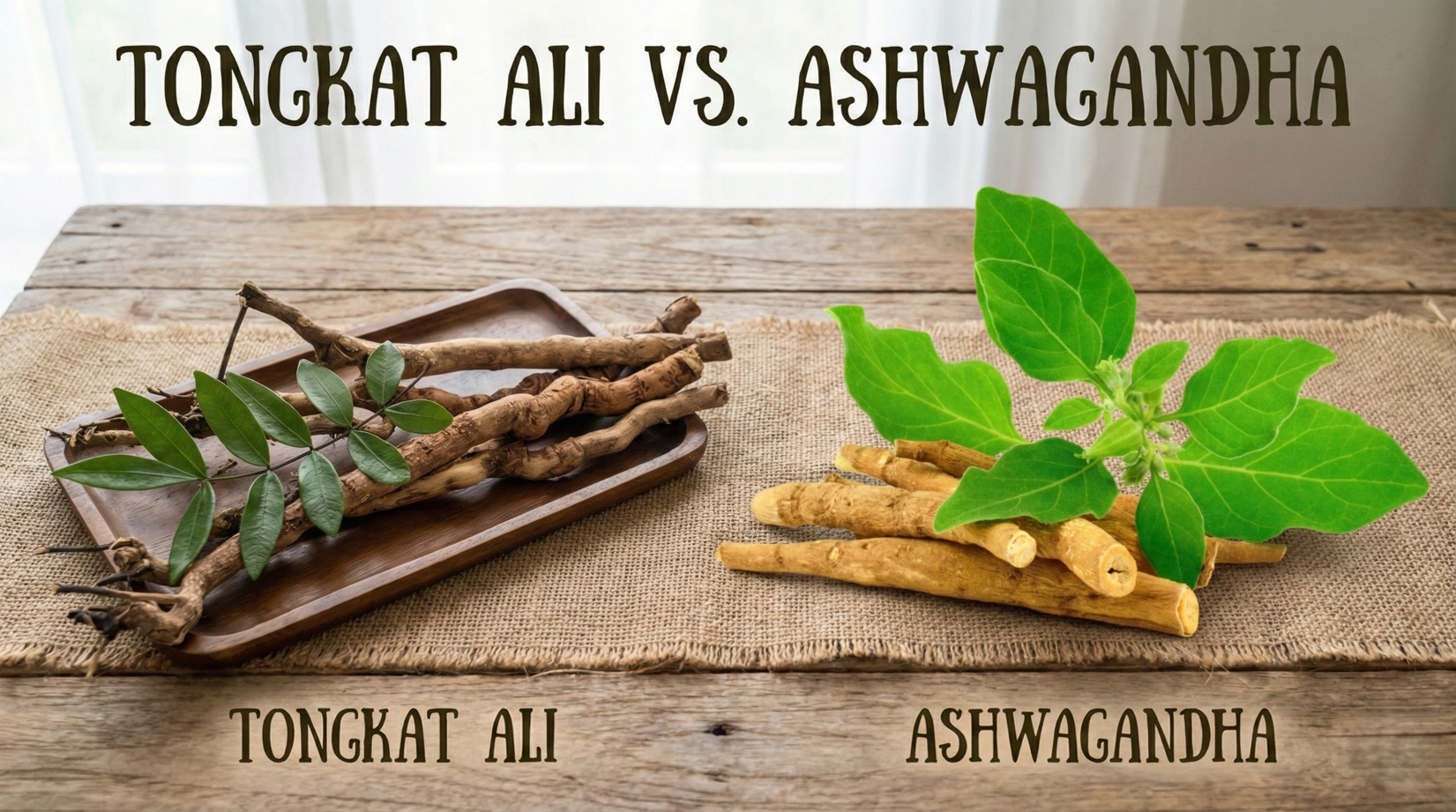
In the rapidly evolving landscape of men’s health and biohacking, two botanical giants consistently dominate the conversation: Tongkat Ali and Ashwagandha. For men aged 25 to 45 who are seeking to optimize their hormonal health naturally, standing in the supplement aisle or browsing online can feel overwhelming.
While both herbs are revered for their ability to enhance vitality, their biological mechanisms are fundamentally different. One acts as a targeted testosterone liberator, while the other serves as a master stress modulator. In this comprehensive guide, we will dissect the science, benefits, and protocols of these herbs to help you decide which one fits your physiology or if you should employ them together for a synergistic effect.
The Contenders: A Medical Overview
To make an informed decision, it is crucial to understand the biological heritage and pharmacological profile of each plant. Both have been utilized for centuries in their respective cultures, yet modern science has only recently begun to validate their specific biochemical pathways.
Tongkat Ali: The Malaysian Warrior
Scientifically known as Eurycoma longifolia, Tongkat Ali is native to the dense rainforests of Southeast Asia. In traditional medicine, particularly in Malaysia and Vietnam, it has been used primarily as an aphrodisiac, anti-malarial, and anti-diabetic agent. However, modern clinical data highlights its potent role as an ergogenic aid.
The primary bioactive compounds in Tongkat Ali are quassinoids, specifically eurycomanone. Research indicates that these compounds assist in releasing “free” testosterone from Sex Hormone Binding Globulin (SHBG). When testosterone is bound to SHBG, it is biologically inactive; by freeing it, Tongkat Ali effectively increases the bioavailable testosterone your body can actually utilize for muscle repair and mood regulation.
Ashwagandha: The Smell of the Horse
Ashwagandha (Withania somnifera) is the cornerstone of Ayurvedic medicine, often referred to as “Indian Ginseng,” though it is botanically distinct. It is classified as an adaptogen, a unique class of herbs that helps the body maintain homeostasis during periods of physical or emotional stress.
The primary active components here are withanolides. Unlike Tongkat Ali, which acts directly on the gonadal axis, Ashwagandha works primarily on the Hypothalamic-Pituitary-Adrenal (HPA) axis. By regulating cortisol (the primary stress hormone), it creates a physiological environment where testosterone production can thrive rather than being suppressed by chronic stress.
Read more “Low Testosterone Symptoms and How to Recognize Them Early”
Tongkat Ali vs Ashwagandha for Testosterone
When the primary objective is maximizing male hormones, the debate of Tongkat Ali vs Ashwagandha for testosterone requires a nuanced look at your personal health markers. Both can increase testosterone, but they achieve this via different “pathways.”
The Direct Approach: Tongkat Ali
Tongkat Ali is arguably the superior choice if your sole objective is increasing Leydig cell stimulation and liberating free testosterone. A systematic review published in the Journal of the International Society of Sports Nutrition found that Tongkat Ali supplementation significantly increased testosterone levels in men with late-onset hypogonadism.
Furthermore, studies suggest it may inhibit the aromatase enzyme, which converts testosterone into estrogen. This ensures your hormonal profile remains androgen-dominant. This direct mechanism makes it a favorite among bodybuilders and men suffering from age-related hormonal decline.
- Medical Verdict: If you have low libido, low energy, or clinically low free testosterone, Tongkat Ali acts as a direct stimulant for the reproductive system. For pure herbal extracts that target this pathway, check out the offerings at svkherbal.com.
The Indirect Approach: Ashwagandha
Ashwagandha’s testosterone-boosting capabilities are largely a secondary effect of its stress-busting properties. Chronic stress leads to chronically elevated cortisol; cortisol has an inverse relationship with testosterone (as one goes up, the other goes down). By significantly lowering serum cortisol levels – with some studies showing reductions of nearly 30% – Ashwagandha allows the body’s natural testosterone production to recover and normalize.
- Medical Verdict: If your low testosterone is caused by high-stress lifestyle factors, poor sleep, or “executive burnout,” Ashwagandha is likely the better initial intervention.
Learn about “Top 10 Natural Herbal Supplements to Boost Testosterone Levels Naturally”
The Battle for Stress and Mental Performance
While testosterone is vital, mental resilience is the foundation of overall health. Here, we analyze how these herbs stack up regarding anxiety, cognition, and mood.
Ashwagandha: The King of Calm
In the context of stress relief, Ashwagandha is undisputed. Randomized double-blind, placebo-controlled trials have repeatedly demonstrated its efficacy in reducing anxiety scores on the Hamilton Anxiety Rating Scale. It modulates GABA receptors in the brain, functioning somewhat similarly to mild anxiolytics but without the heavy sedation associated with pharmaceuticals. This makes it ideal for the “wired but tired” phenotype – men who are exhausted but cannot shut off their brains at night.
Tongkat Ali: Focused Aggression
Tongkat Ali does not act as a sedative. Instead, it improves what researchers call “mood state parameters.” Research indicates that while it lowers cortisol moderately, its main mental benefit is reducing fatigue and tension while improving focus. It provides a “driven” feeling rather than a “relaxed” feeling. For athletes or professionals needing competitive focus, this “assertive” energy is often preferred over the calming effect of Ashwagandha.
Physical Performance and Muscle Growth
For the fitness enthusiasts and biohackers reading this, the metric that often matters most is body composition.
Tongkat Ali for Strength
Due to its direct impact on free testosterone, Tongkat Ali has been shown to improve lean muscle mass and muscular strength in active individuals. A pilot study published in the British Journal of Sports Medicine indicated that men using Tongkat Ali saw greater increases in arm circumference compared to placebo groups during a strength training program. It acts as an anabolic support agent.
Ashwagandha for Recovery
Ashwagandha shines in recovery and cardiorespiratory endurance. Studies involving elite cyclists and sprinters have shown that Ashwagandha supplementation increases VO2 max. Furthermore, by reducing exercise-induced muscle damage (stabilizing creatine kinase levels), it allows athletes to train more frequently without burning out.
Can You Take Tongkat Ali and Ashwagandha Together?
This is perhaps the most common question I receive in my practice: Can you take Tongkat Ali and Ashwagandha together? The short answer is yes, and for many men, it is the optimal strategy.
The Benefits of Stacking Tongkat Ali and Ashwagandha
Stacking these two herbs creates a dual-pronged approach to male health that addresses both production and preservation:
- Hormonal Optimization: You get the direct testosterone stimulation and SHBG reduction from Tongkat Ali (The Gas Pedal).
- Catabolic Protection: You get the cortisol protection from Ashwagandha, preventing your stress hormones from breaking down the testosterone you just produced (Releasing the Brake).
- Energy Balance: Ashwagandha’s calming nature can offset the slight over-stimulation or restlessness some sensitive users feel from high-dose Tongkat Ali.
Check out “Low Testosterone Symptoms and How to Recognize Them Early”
Dosage, Safety, and Protocols
As a doctor, I must emphasize that “natural” does not mean “harmless.” Proper dosing is essential for efficacy and safety to avoid adverse effects.
Tongkat Ali Protocol
- Dosage: 200mg to 400mg of a standardized extract daily. Look for extracts standardized to 1-2% Eurycomanone for potency.
- Cycling: It is highly recommended to cycle Tongkat Ali to prevent receptor downregulation. A common protocol is 5 days on, 2 days off, or 4 weeks on, 1 week off.
- Side Effects: Can cause restlessness, increased body temperature, or insomnia if taken too late in the day.
Ashwagandha Protocol
- Dosage: 300mg to 600mg of full-spectrum root extract (such as KSM-66 or Sensoril).
- Timing: Best taken in the evening or post-workout due to its potential calming and sedative effects.
- Side Effects: Generally well tolerated, though high doses can cause digestive upset or lethargy.
Beyond the Basics: Interesting Botanical Facts
To truly appreciate these herbs, we must look beyond the supplement label. Here are some fascinating details about the Tongkat Ali vs Ashwagandha origins that usually go unnoticed.
- The “Walking Stick”: In Malay, “Tongkat Ali” translates to “Ali’s Walking Stick.” While this is often interpreted as a reference to male virility (a phallic metaphor), it also refers to the plant’s long, twisted taproots that penetrate deep into the soil. These roots are notoriously difficult to harvest. Research on traditional harvesting methods highlights the intense labor involved, contributing to its premium price compared to other herbs.
- Horse Power: The name “Ashwagandha” is Sanskrit for “Smell of the Horse” (Ashwa = horse, Gandha = smell). This is literal – the fresh root has a strong, earthy, horse-like odor. Metaphorically, however, it promises the strength, stamina, and virility of a stallion to those who consume it.
- The Taste Test: True Tongkat Ali is incredibly bitter due to the quassinoids. In Vietnam, it is known as Cay Ba Binh (The Plant that Cures 100 Diseases) or Mat Nhan (Bitter Tone). If your Tongkat Ali supplement tastes sweet or neutral without a capsule, it is likely fake or heavily filled with rice flour. You can read more about authentic herbal identification and quality assurance at naturem.us.
- Evolutionary Defense: The compounds in Tongkat Ali that boost our testosterone (Eurycomanone) were actually evolved by the plant as a defense mechanism to stop insects from eating it. We are essentially biohacking plant warfare chemicals for our own hormonal gain.
Naturem™ Stamina Capsules – Supporting Stamina Under Stress and Hormonal Pressure
Many of the conditions discussed in this article share a common physiological thread: chronic stress, neuroendocrine imbalance, and depleted vitality. Elevated cortisol, sympathetic nervous system dominance, and inflammatory signaling do not only affect sexual health. Over time, they erode overall stamina, mental resilience, and physical endurance.

Naturem™ Stamina Capsules are formulated to support the body during periods of prolonged pressure rather than to force stimulation. Instead of acting as a short-term energizer, the formula focuses on restoring balance at the systems level.
Key ingredients such as Rhodiola Rosea and Cuscuta Hygrophilae work synergistically to boost energy levels, improve blood flow, and reduce stress, while Herba Cistanches and Morinda Officinalis target kidney health and libido. Easy to incorporate into daily routines, Naturem™ Stamina Capsules provide a safe and effective way to reclaim energy, endurance, and overall well-being.
As always, consult a healthcare professional before use, especially if you have underlying health conditions or are taking medications.
Frequently Asked Questions (FAQ)
Ashwagandha typically works faster for stress relief, with users reporting better sleep and reduced anxiety within 1-2 weeks. Tongkat Ali acts on hormonal levels, which takes longer to manifest physically; expect to wait 4-8 weeks for noticeable muscle and libido changes. Studies on supplementation duration confirm this timeline.
Yes. Ashwagandha is excellent for women for stress reduction and thyroid support. Tongkat Ali can be used by women for energy and libido, but at much lower doses (50-100mg) to avoid potential androgenic side effects like acne or voice changes.
Unlike Tongkat Ali, Ashwagandha does not necessarily require strict cycling, but many practitioners recommend taking a 2-week break every 3-4 months to ensure the body remains responsive to the adaptogenic effects.
Both herbs have mild hypoglycemic (blood sugar lowering) effects. If you are diabetic or on medication, monitor your levels closely, as research suggests an additive effect could occur.
This is a tricky area. Ashwagandha helps reduce stress-induced hair loss (Telogen Effluvium). However, because Tongkat Ali raises testosterone, it could theoretically increase DHT conversion in predisposed men, though this is rare. If stress is the primary cause of your hair loss, Ashwagandha is the superior choice.
References
Chandrasekhar, K., Kapoor, J., & Anishetty, S. (2012). A prospective, randomized double-blind, placebo-controlled study of safety and efficacy of a high-concentration full-spectrum extract of ashwagandha root in reducing stress and anxiety in adults. Indian Journal of Psychological Medicine, 34(3), 255-262. https://doi.org/10.4103/0253-7176.106022
George, A., & Henkel, R. (2014). Phytoandrogenic properties of Eurycoma longifolia as natural alternative to testosterone replacement therapy. Andrologia, 46(7), 708-721. https://doi.org/10.1111/and.12214
Hamzah, S., & Yusof, A. (2003). The ergogenic effects of Eurycoma longifolia Jack: A pilot study. British Journal of Sports Medicine, 37(5), 464-470. https://doi.org/10.1136/bjsm.37.5.464
Lopresti, A. L., Smith, S. J., Malvi, H., & Kodgule, R. (2019). An investigation into the stress-relieving and pharmacological actions of an ashwagandha (Withania somnifera) extract: A randomized, double-blind, placebo-controlled study. Medicine, 98(37), e17186. https://doi.org/10.1097/MD.0000000000017186
Talbott, S. M., Talbott, J. A., George, A., & Pugh, M. (2013). Effect of Tongkat Ali on stress hormones and psychological mood state in moderately stressed subjects. Journal of the International Society of Sports Nutrition, 10(1), 28. https://doi.org/10.1186/1550-2783-10-28
Wankhede, S., Langade, D., Joshi, K., Sinha, S. R., & Bhattacharyya, S. (2015). Examining the effect of Withania somnifera supplementation on muscle strength and recovery: A randomized controlled trial. Journal of the International Society of Sports Nutrition, 12, 43. https://doi.org/10.1186/s12970-015-0104-9