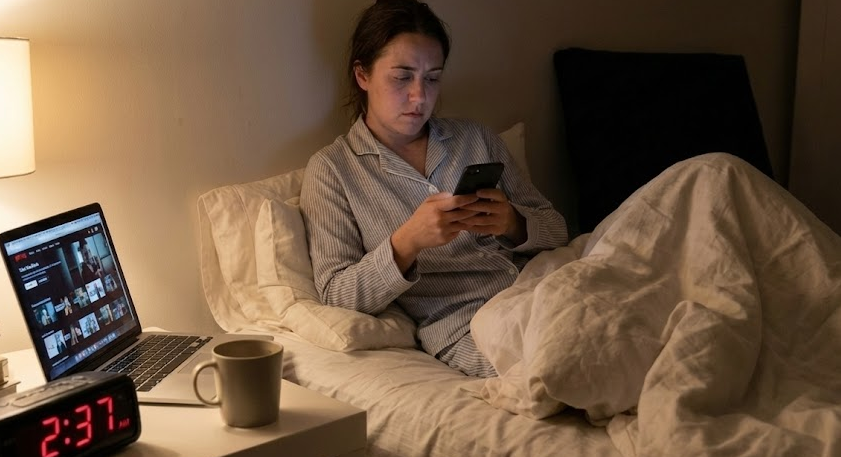
In the quiet darkness of your room, the only light comes from your smartphone screen, glowing directly onto your tired face. The clock has already struck 1 AM. A part of your brain is screaming for rest, yet your fingers continue to scroll, your eyes glued to mindless short videos.
This is not a harmless habit; it is the phenomenon known as “Sleep Procrastination” – a silent civil war between your rational self and your longing for freedom.
The Essence of “Revenge” Bedtime Procrastination

The full term for this phenomenon is “Revenge Bedtime Procrastination.” This concept first gained popularity to describe individuals whose daytime schedules are tightly controlled by work or family responsibilities, leading them to seek “revenge” at night to reclaim a sense of agency over their lives.
According to research from the Sleep Foundation, this is not a clinical sleep disorder (like insomnia), but rather a self-regulation failure. You actively choose to stay awake, despite being fully aware of the negative consequences waiting for you the next morning.
Why Does Your Brain “Betray” You at Night?

Why do we engage in this self-sabotaging behavior? There are three core psychological and biological mechanisms at play:
Willpower Depletion
Harvard Health explains that human self – control is like a battery. After a long day of making hundreds of decisions at work, suppressing personal emotions, and managing pressure, this willpower battery is drained by evening. At that point, you no longer have the mental energy to perform the “right but boring” action: going to sleep. You choose the path of least resistance: Continuing to scroll.
The Need for Agency (Control)
If your daytime is filled with the demands of bosses, clients, or children, nighttime is the only period where you don’t have to serve anyone else. Staying awake is an act of reclaiming autonomy: “This is the only time in the day I truly belong to myself.”
The Hormonal Trap: Dopamine and Melatonin
When you stay up late and entertain yourself with social media, your brain releases Dopamine – the hormone of instant gratification. Simultaneously, the blue light emitted from electronic screens suppresses the production of Melatonin (the sleep-inducing hormone).
This combination creates a dangerous loop: the brain is stimulated (by Dopamine) while being tricked into thinking it is still daylight (due to lack of Melatonin), resulting in a state of artificial alertness even though the body is exhausted.
The Price of Procrastination: “Sleep Debt” and Metabolic Health

Chronic sleep procrastination leads to an accumulation of Sleep Debt. According to the National Institutes of Health (NIH), chronic sleep deprivation does more than just cause dark circles or fatigue; it ravages the body from within:
- Cognitive Decline: It reduces focus, impairs short-term memory, and causes “brain fog,” significantly lowering productivity the next day.
- Emotional Dysregulation: Lack of sleep weakens the connection between the amygdala (the emotional center) and the prefrontal cortex (the rational center), making you more irritable, anxious, and stressed.
- Metabolic Consequences: Sleep deprivation disrupts blood sugar control and increases the hunger hormone (Ghrelin) while decreasing the fullness hormone (Leptin), leading to a higher risk of obesity and Type 2 Diabetes.
The data from the NIH clarifies a fundamental truth: chronic sleep deprivation is not merely a matter of fatigue, but an internal “crisis” for the body. As Sleep Debt accumulates, it triggers a toxic cycle: the brain loses its sharpness, emotions become unstable, and most critically, the metabolic system is severely compromised.
The imbalance between Ghrelin and Leptin caused by lack of sleep will drive you to eat faster, consume more, and crave sugar the following day – placing immense pressure on your blood glucose levels and pancreas.
A 4-Step Strategy to Reclaim Your Sleep
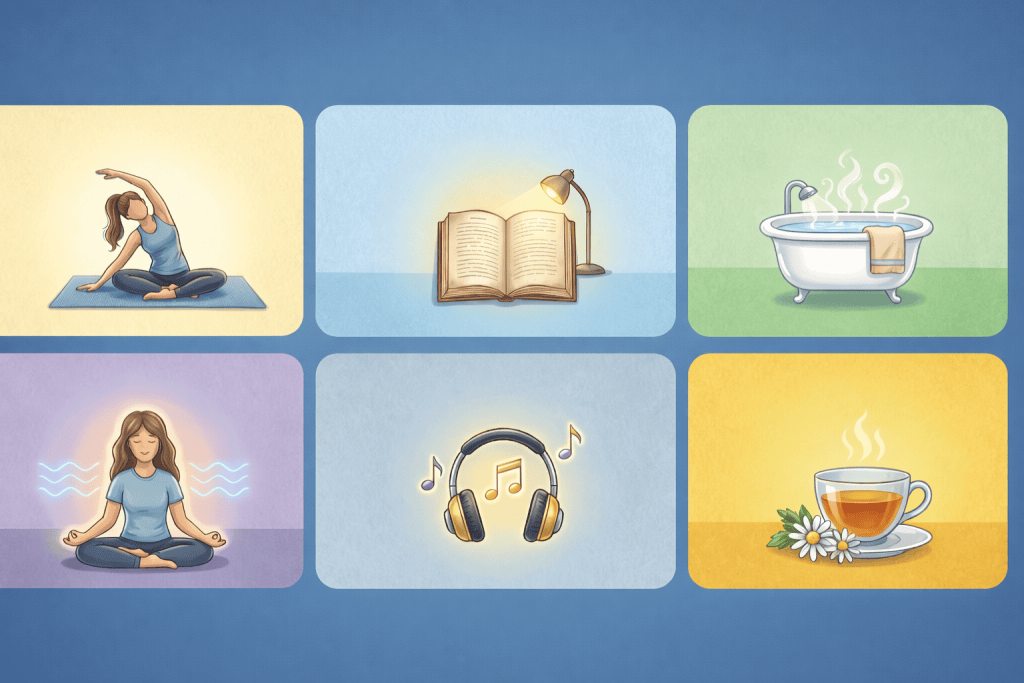
To break this cycle, you need behavioral intervention strategies rather than relying solely on willpower:
- Establish a “Buffer Zone“: Don’t try to force yourself to sleep while in a state of high stimulation. Dedicate at least 30 – 60 minutes before bed to screen – free activities such as reading a physical book, light meditation, or preparing your clothes for the next day.
- Physical Disconnection: Leave your phone in another room or far away from your bed. Physical distance increases the “friction” for procrastination, making you less likely to reach for the device.
- Satisfy Your Need for Freedom During the Day: Spend at least 15 – 30 minutes during your lunch break or after work doing something entirely for yourself. When your psychological need for “me-time” is met during the day, the urge for “revenge” at night will diminish.
- Medical-Grade Sleep Hygiene: Keep your bedroom completely dark and cool (around 18 – 22°C). Lower temperatures help the body enter a deep sleep state more easily.
Managing blood sugar is not just about what we eat; it is deeply tied to how we rest. Poor sleep quality, often caused by “Revenge Bedtime Procrastination,” spikes Cortisol levels, directly disrupting blood glucose regulation and triggering intense food cravings the following morning.
Naturem™ Memory+: A Comprehensive Solution for Mental Clarity & Brain Health

In today’s high-pressure lifestyle, maintaining a sharp memory and laser-like focus is the key to success. Naturem™ Memory+ is more than just a supplement; it is an intelligent guardian for your brain.
Designed with an advanced formula, Naturem™ Memory+ acts deeply on neural cells to deliver breakthrough results:
- Enhanced Cognitive Function: Significantly improves memory retention, concentration, and information processing speed.
- Optimized Cerebral Circulation: Supports healthy brain blood flow, helping to reduce fatigue and headaches caused by poor circulation.
- Neuron Regeneration: Promotes the recovery and regeneration of neurons, keeping your brain “youthful” and resilient.
- Brain-Gut Balance: A unique feature of this product is its ability to support the gut microbiome, improving mood and brain health at its source.
- Anti-Aging Protection: Boosts powerful antioxidant activity to protect the brain from free radicals and may support the management of Alzheimer’s symptoms.
Naturem™ Memory+ is the ideal solution for: High-performing professionals, students during exam seasons, and seniors looking to prevent memory decline.
Frequently Asked Questions
This is often the “second wind” phenomenon. When you push past your natural sleep window, the body may release Cortisol (the stress hormone) to keep you awake. This is an ancient survival mechanism that is counterproductive in modern society. Sleep Foundation – Circadian Rhythm
In reality, the opposite is true. Scrolling is a form of passive entertainment that consumes mental energy (due to processing a constant stream of information) rather than restoring it. You feel “satisfied” in the moment, but your brain is actually getting more exhausted. Cleveland Clinic – Why blue light is bad for sleep
Not necessarily. People with perfectionist tendencies or those who struggle with emotional regulation often use staying awake as a way to avoid anxious thoughts about the coming day. Frontiers in Psychology – Bedtime Procrastination
If you feel the need for caffeine to stay alert in the morning, frequently feel drowsy during meetings, or find yourself getting irritable for no reason, these are signs your body is in serious sleep debt. Mayo Clinic – Sleep Deprivation
References
American Psychological Association. (2022). Why we stay up late even when we’re tired. https://www.apa.org/topics/sleep/stay-up-late
Harvard Health Publishing. (2020, July 7). Sleep and mental health. Harvard Medical School. https://www.health.harvard.edu/newsletter_article/sleep-and-mental-health
Kroese, F. M., De Ridder, D. T., Catharine Evers, C., & Adriaanse, M. A. (2014). Bedtime procrastination: Introducing a new area of procrastination. Frontiers in Psychology, 5, 611. https://doi.org/10.3389/fpsyg.2014.00611
National Institutes of Health. (2023). Brain basics: Understanding sleep. National Institute of Neurological Disorders and Stroke. https://www.ninds.nih.gov/health-information/public-education/brain-basics/brain-basics-understanding-sleep
Suni, E., & Vyas, N. (2023, December 8). What is revenge bedtime procrastination? Sleep Foundation. https://www.sleepfoundation.org/sleep-hygiene/revenge-bedtime-procrastination
World Health Organization. (2024). Technical brief on sleep and health. https://www.who.int/news-room/fact-sheets
Zhang, M. X., & Wu, A. M. (2020). Effects of reward and punishment on bedtime procrastination: A study of the Chinese “Revenge Bedtime Procrastination” phenomenon. International Journal of Environmental Research and Public Health, 17(7), 2411. https://doi.org/10.3390/ijerph17072411