
When you are in the grip of a stressful moment, advice like just relax rarely helps. You need something practical that works within minutes, whether before a meeting, during an anxiety spike, or late at night when your mind will not slow down.
These 5-minute mental health exercises are designed for immediate application. By influencing breathing rhythm and autonomic regulation, they help your body shift out of the stress response quickly and safely.
The fastest way to calm down in five minutes is through controlled breathing and sensory grounding. Slow, extended exhales activate the parasympathetic nervous system, lowering heart rate and easing physiological arousal. Techniques such as the Physiological Sigh, Box Breathing, and 5-4-3-2-1 grounding are practical methods you can use anywhere.
How to Calm Down When Feeling Overwhelmed
When overwhelm hits, your brain’s alarm system (the amygdala) hijacks your logical center (the prefrontal cortex). To regain control, you must signal safety to your body directly through your breath. This is one of the most reliable ways to calm down quickly during acute stress.
Exercise 1: The Physiological Sigh
Research in stress physiology suggests this may be one of the fastest ways to lower acute stress in real time.
- When to use it: Immediately after receiving bad news, during a panic spike, or when you feel like you can’t catch your breath.
- Step-by-step:
- Inhale deeply through your nose.
- At the top of that inhale, take a second, shorter inhale through your nose (to fully inflate the alveoli in your lungs).
- Exhale slowly and fully through your mouth, making a soft sighing sound.
- Repeat 2–3 times.
- Nervous system check: The second inhale allows the lungs to expand more fully, improving carbon dioxide release. The extended exhale then signals the vagus nerve, which naturally slows heart rate and reduces stress activation.
- Common mistake: Rushing the exhale. The magic is in the slow release of air.
Exercise 2: Box Breathing (4-4-4-4)
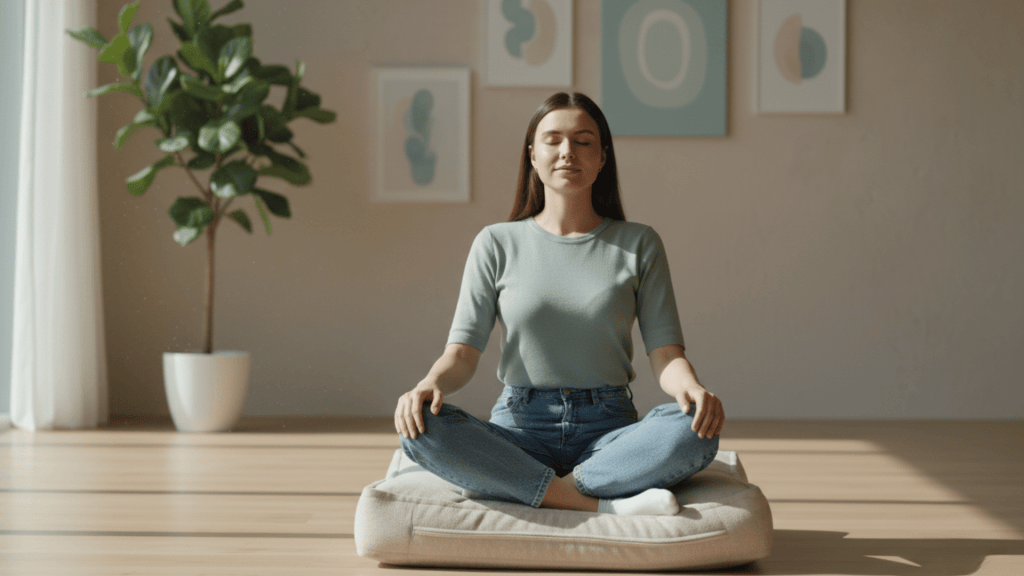
This technique is commonly used in high-pressure environments to restore composure and focus. It regulates the autonomic nervous system by stabilizing breathing rhythm.
- When to use it: When you need to regain composure and focus before a high-stakes task.
- Step-by-step:
- Inhale through your nose for a count of 4.
- Hold the breath for a count of 4.
- Exhale through your mouth for a count of 4.
- Hold the empty breath for a count of 4.
- Repeat for 4 cycles (approx. 1 minute).
- Nervous system check: The rhythmic holding creates a buildup of CO2 tolerance and forces your heart rate to synchronize with your breath, inducing a state of alert calm.
- Common mistake: Tensing the shoulders during the hold. Keep your body loose.
How to Stop Racing Thoughts Quickly
Anxiety often pulls us into the future (What if…?). Grounding techniques are designed to pull you back into the present moment, re-engaging your logical brain. This is especially useful if you are wondering how to stop racing thoughts quickly during anxiety.
For a deeper dive into how mindfulness supports anxiety regulation, explore Mindfulness-Based Cognitive Therapy (MBCT). For now, try this rapid sensory check.
Exercise: The 5-4-3-2-1 Technique

- When to use it: When your mind is spinning with what ifs, or you feel detached from reality (dissociation).
- Step-by-step:
- Acknowledge 5 things you see: A lamp, a crack in the wall, your own hand.
- Acknowledge 4 things you can touch: The fabric of your chair, your hair, the cool desk surface.
- Acknowledge 3 things you hear: Distant traffic, computer hum, your breath.
- Acknowledge 2 things you can smell: Coffee, fresh air (or engage a scent you like).
- Acknowledge 1 thing you can taste: A sip of water, or just the sensation in your mouth.
- Nervous system check: This technique forces the prefrontal cortex to come online to categorize sensory data, dampening the activity of the emotional brain.
- Common mistake: Doing it mechanically. You must actually focus on the texture or color of the object for a second or two.
What to Do When Your Body Feels Tense
Mental stress often manifests physically as tight shoulders, a clenched jaw, or a knot in the stomach. You might not even realize you are holding tension until you actively release it.
Exercise: Progressive Muscle Relaxation (PMR) – The Squeeze and Release
While a full session can take 20 minutes, a rapid 5-minute version is highly effective for Progressive Muscle Relaxation.
- When to use it: When you feel stiff, have a tension headache, or feel jumpy.
- Step-by-step:
- Hands & Arms: Clench your fists and tighten your biceps hard. Hold for 5 seconds. Exhale and release instantly (don’t ease out—let go suddenly). Notice the difference.
- Face & Shoulders: Scrunch your face up and shrug your shoulders to your ears. Hold for 5 seconds. Release suddenly.
- Legs & Feet: Curl your toes and squeeze your thighs. Hold for 5 seconds. Release suddenly.
- Scan your body for any remaining tension.
- Nervous system check: By voluntarily creating maximum tension, you fatigue the muscle mechanism, allowing it to relax more deeply than before. It teaches the brain to recognize the contrast between stress and safety.
- Common mistake: Forgetting to breathe while tensing. Keep breathing throughout.
How to Reduce Stress Fast at Work
Work environments often prevent us from closing our eyes or lying down. In these situations, you need discreet methods for quick anxiety relief that can be done at a desk without drawing attention.
Exercise: The Palming Reset
- When to use it: After staring at a screen for hours or after a stressful email.
- Step-by-step:
- Rub your hands together vigorously until they feel warm.
- Cup your palms over your closed eyes (without pressing on the eyeballs).
- Visualize the color black.
- Breathe deeply for 60 seconds, feeling the warmth penetrate the eyes.
- Nervous system check: This temporarily reduces visual input, which is one of the brain’s largest sources of sensory processing demand.
- Common mistake: Pressing on the eyelids, which can cause blurry vision afterward.
For a broader framework that integrates multiple stress-regulation strategies, you may explore a more comprehensive guide to mental health exercises for long-term resilience.
How to Calm Anxiety Before Bed
Racing thoughts at night are a common symptom of high cortisol. Without intervention, poor sleep disrupts hormones, creating a cycle of stress the next day.
Exercise: The 4-7-8 Breathing Technique

- When to use it: Lying in bed when you cannot drift off.
- Step-by-step:
- Place the tip of your tongue against the ridge of tissue just behind your upper front teeth.
- Exhale completely through your mouth, making a whoosh sound.
- Inhale quietly through the nose to a count of 4.
- Hold the breath for a count of 7.
- Exhale completely through the mouth, making a whoosh sound to a count of 8.
- Repeat for 4 cycles.
- Nervous system check: The long exhale is the key trigger for the parasympathetic nervous system (the relaxation response), acting as a natural tranquilizer for the nervous system.
- Common mistake: Doing too many cycles if you are a beginner (it can cause lightheadedness). Stick to 4 cycles initially.
To understand more about the biological link between rest and anxiety, explore the link between sleep quality and stress regulation.
When 5-Minute Relief Isn’t Enough
These exercises are powerful tools for acute stress—the immediate, temporary reaction to a challenge. However, if you find yourself needing these techniques constantly, or if the stress feels heavy and unshakeable regardless of your efforts, you may be dealing with chronic stress.
Chronic stress operates very differently from short-term stress. It is a prolonged state of physiological arousal that can lead to burnout, metabolic issues, and long-term health decline. While quick breathing exercises help manage the symptoms, chronic stress often requires lifestyle changes, nutritional support, and potentially professional guidance to address the root cause.
It is vital to distinguish between a bad day and a systemic issue. If you suspect your stress has become a constant baseline state, learning how chronic stress affects the body and brain over time becomes essential, as long-term activation of the stress response alters physiology very differently from temporary overwhelm.
Short bursts of stress are part of daily life, but knowing how to regulate your nervous system quickly can prevent temporary pressure from escalating into prolonged distress. These five-minute techniques provide practical stress management tools you can use anywhere to restore physiological balance and mental clarity.
Frequently Asked Questions (FAQs)
The fastest physiological route to calm anxiety is through the breath. Techniques like the Physiological Sigh (two inhales, one long exhale) or Box Breathing (inhale 4, hold 4, exhale 4, hold 4) communicate safety to the brain almost instantly. Combining this with a grounding technique like 5-4-3-2-1 can help stop the mental loop of anxious thoughts.
Yes. Breathing exercises are effective because respiratory patterns directly influence heart rate variability and vagal tone, both of which regulate the stress response. In practical terms, slowing your exhale sends a signal of safety to the brain. That signal reduces heart rate and lowers physiological arousal within minutes.
If stress returns immediately after these exercises, you may be experiencing chronic stress rather than acute stress. While these 5-minute tools are excellent for symptom management, recurrent stress requires a broader approach, including sleep hygiene, regular exercise, boundary setting, and perhaps professional therapy.
Absolutely. Box breathing and grounding (5-4-3-2-1) can be done invisibly during a meeting or on a commute. No one needs to know you are regulating your nervous system. Progressive Muscle Relaxation can also be modified (e.g., just tensing and releasing the fists or toes) to be discreet.
References
- American Psychological Association. (2023). Stress effects on the body. https://www.apa.org/topics/stress/body
- Harvard Health Publishing. (2020). Relaxation techniques: Breath control helps quell errant stress response. https://www.health.harvard.edu/mind-and-mood/relaxation-techniques-breath-control-helps-quell-errant-stress-response
- Huberman, A. (2021). Tools for Managing Stress & Anxiety. Huberman Lab. https://hubermanlab.com/tools-for-managing-stress-and-anxiety/
- National Institute of Mental Health. (2023). Anxiety Disorders. https://www.nimh.nih.gov/health/topics/anxiety-disorders