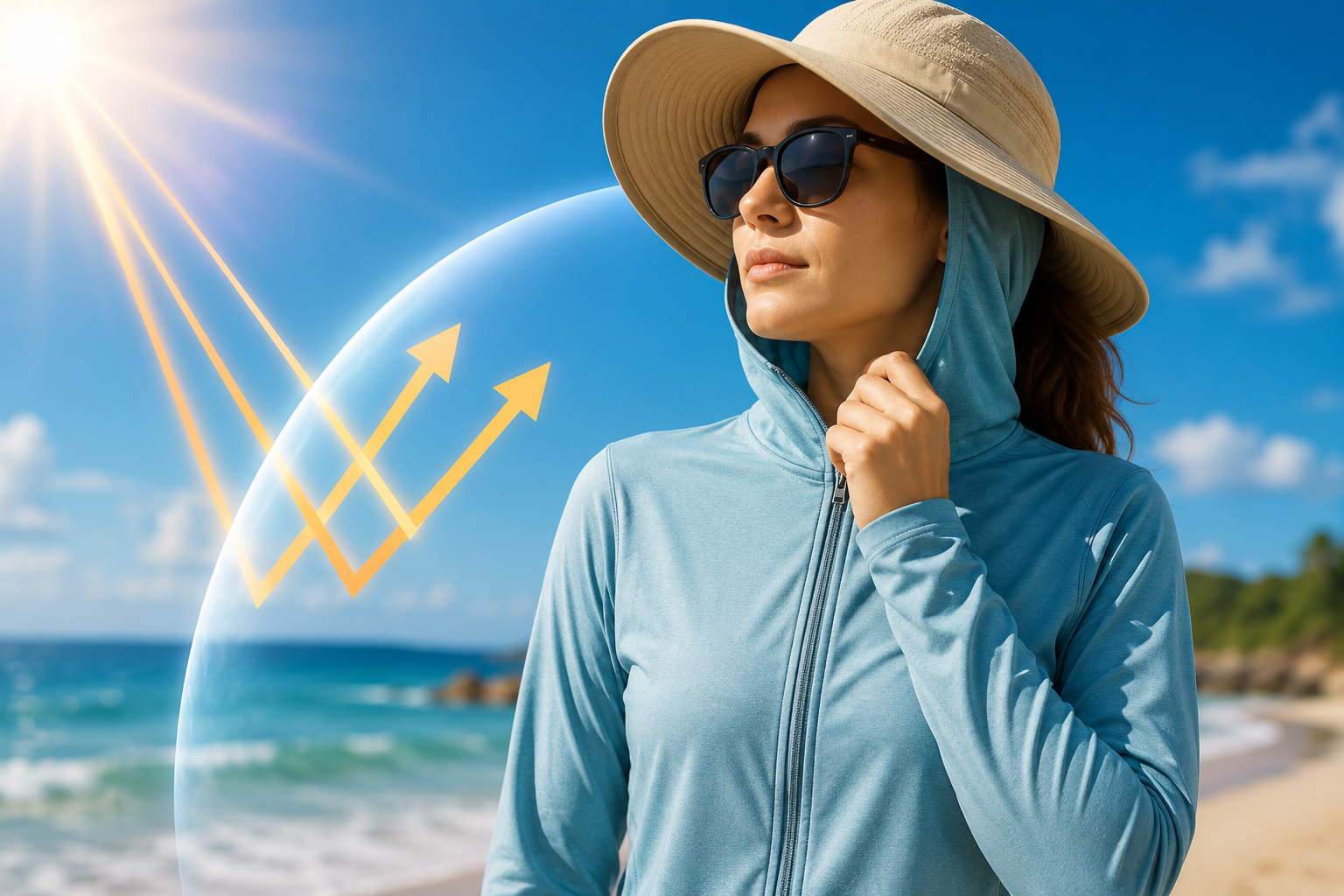
You have seen the labels on outdoor shirts, swimwear, and rash guards: “UPF 50+.” You may have wondered whether this is a genuine scientific claim or just clever marketing designed to sell premium activewear at a higher price point. The answer matters, because the consequences of inadequate UV protection – premature skin aging, immune suppression, DNA damage, and skin cancer – are among the most preventable health burdens modern medicine faces.
This article gives you a complete, science-based answer. We will explain exactly how sun-protective clothing works, what UPF ratings actually measure, which fabric properties determine UV-blocking effectiveness, how UPF clothing compares to sunscreen, and – critically – how to maximize your total UV defense strategy by combining physical protection with internal antioxidant support.
The Scale of the Problem: Why UV Protection Matters
Before examining the technology, it is worth establishing the clinical stakes. UV radiation significantly impacts the skin, causing photoaging, sunburns, precancerous lesions, cancerous changes, and immunosuppression. The global incidence of skin cancer is substantial: in 2019 alone, there were an estimated 4 million cases of basal cell carcinoma, 2.4 million cases of squamous cell carcinoma, and 0.4 million cases of melanoma worldwide – and incidence rates have been rising steadily since 1990.
The annual cost of treating skin cancer in the U.S. alone is estimated at approximately USD 8.1 billion, comprising roughly USD 4.8 billion for non-melanoma skin cancers and USD 3.3 billion for melanoma. Beyond cancer, photoaging – primarily driven by UV exposure – accounts for approximately 80% of visible skin aging including wrinkles, sagging, pigmentation changes, and loss of elasticity. These are not cosmetic inconveniences; they reflect real, cumulative cellular damage to the skin’s structural architecture.
The good news is that UV radiation is among the most modifiable environmental risk factors in medicine. Physical barriers – including clothing – represent the most reliable and consistent form of UV protection available, outperforming sunscreen in several important ways.
What Is UPF and How Is It Measured?
UPF stands for Ultraviolet Protection Factor. It is the clothing equivalent of SPF – but technically more comprehensive. UPF indicates how much UV radiation, both UVB and UVA, a fabric allows to reach your skin. SPF, by contrast, only measures a sunscreen’s effectiveness against UVB rays – the shorter wavelength rays primarily responsible for sunburn. UPF measures both:
- UVB rays (290-320 nm): cause sunburn, DNA mutations in skin cells, and are most carcinogenic
- UVA rays (320-400 nm): penetrate deeper into the dermis, promoting collagen degradation, oxidative stress, and photoaging
A UPF 50 fabric blocks 98% of UV rays, allowing only 1/50th – or 2% – of radiation to reach the skin. A UPF 30 fabric blocks approximately 96.7%, allowing 3.3% to penetrate. Unlike SPF measurements, which traditionally use human sunburn testing, UPF is measured using a laboratory spectrophotometer with an artificial light source, applying a sunburn weighting curve across relevant UV wavelengths – a more controlled and reproducible measurement methodology.
The ASTM (American Society for Testing and Materials) and Australian/New Zealand standard AS/NZS 4399 are the two primary testing frameworks used globally. Under these systems, the UPF rating categories are:
| UPF Rating | Protection Category | UV Radiation Blocked |
|---|---|---|
| UPF 15-24 | Good protection | 93.3% – 95.9% |
| UPF 25-39 | Very good protection | 96.0% – 97.4% |
| UPF 40-50+ | Excellent protection | 97.5% – 98%+ |
The Skin Cancer Foundation requires a minimum UPF rating of 50 for its Seal of Recommendation, which is considered the benchmark of excellence in sun-protective apparel.
Does It Actually Work? What the Evidence Says
The short answer is: yes, definitively. According to head-to-head comparison studies, UPF-rated clothing provides superior sun protection to sunscreen overall and should be considered the cornerstone of UV protection. This is a conclusion supported by dermatologists, oncologists, and public health authorities worldwide.
The advantage of clothing over sunscreen comes down to three key practical differences:
Consistency – Clothing covers its designated area completely and continuously. Sunscreen, by contrast, is applied unevenly – studies show most people apply only 25-50% of the recommended amount – fades, rubs off, washes away in water, and requires reapplication every two hours. Unlike sunscreen, UPF clothing never needs to be reapplied.
Coverage – A long-sleeved UPF shirt protects the entire torso and arms without any gaps, forgotten patches, or uneven application. For large surface areas of the body, this provides a more reliable barrier than topical products.
Durability in water – UPF clothing is specifically designed to offer consistent UV protection wet or dry, something standard clothing does not. A regular wet cotton T-shirt can see its already-low UPF drop further as it becomes translucent and clings to the skin.
The Six Factors That Determine How Well Clothing Blocks UV
Not all clothing is equally protective – and understanding what makes a fabric effective helps you make better purchasing decisions, both for certified UPF garments and for ordinary clothing you already own.
1. Weave Density and Thread Count
This is the most important single factor. Tightly woven fabric provides substantially greater protection than loosely woven clothing. The principle is simple: if you hold a fabric up to a light source and can see light passing through, UV rays can pass through too. Denim, canvas, and tightly woven synthetics offer high protection; gauze, cheesecloth, and open-weave linen offer very little. A tightly woven or high thread-count fabric achieves a higher UPF rating, though this sometimes trades off against comfort and breathability.
2. Color
Dark colors absorb more UV radiation than light colors by preventing more UV rays from reaching your skin. A navy blue shirt typically outperforms a white one of equivalent weave. Bright colors like red and orange also absorb UV effectively, while pale pastels and white fabrics reflect more visible light but allow more UV penetration. However, modern UPF-treated white fabrics can still achieve high ratings through chemical treatment – so color is a reliable guide for untreated fabrics but not the only variable for certified UPF garments.
3. Fabric Composition
Different fibers have inherently different UV-blocking properties. Unbleached cotton contains natural lignins that act as UV absorbers. Shiny polyesters and lightweight satiny silks can be surprisingly protective because they reflect radiation. High-tech fabrics treated with chemical UV absorbers or dyes provide additional protection beyond what the raw fiber would achieve. In general terms, synthetic performance fabrics – polyester, nylon, and specially treated blends – tend to achieve higher UPF ratings than equivalent-weight natural fiber fabrics.
4. Stretch
Clothing with less stretch generally has better UV protection. When fabric stretches, the space between individual fibers increases – widening the gaps through which UV radiation can pass. This is particularly relevant for activewear: yoga pants, stretch tops, and swim shorts that fit very tightly against the body may have lower in-use UPF than their lab rating suggests.
5. Weight
Heavier fabrics provide more UV protection than lighter ones of similar weave. The weight or mass of a fabric is directly related to its cover factor – the proportion of the fabric surface actually covered by fiber versus open space. However, weight trades off against comfort in hot weather, which is why UPF clothing manufacturers work hard to engineer lightweight fabrics that maintain high protection through weave density and chemical treatment rather than sheer mass.
6. Wetness
Dry fabric is generally more protective than wet fabric. When fabric becomes wet and clings to the skin, light transmission increases substantially. A standard wet white cotton T-shirt may provide as little as UPF 3. Certified UPF clothing addresses this by using quick-drying fabrics that regain their full UPF rating rapidly after water exposure – a critical advantage for swimmers, surfers, and water sports enthusiasts.
The Critical Difference: Regular Clothing vs. Certified UPF Clothing
Many people assume that wearing a shirt means their torso is protected. The reality is that most ordinary cotton shirts provide only a UPF of approximately 5 – allowing nearly 20% of UV radiation to pass through to the skin. Compare this to a UPF 50+ rated shirt that allows only 2% transmission, and the protection difference is dramatic: roughly ten times greater protection from a certified garment than from a standard cotton T-shirt.
This gap matters most during extended outdoor exposure – a full day at the beach, a long hike, outdoor work, water sports – where cumulative UV dose is high and consistent protection over many hours is required. For routine daily activity with incidental sun exposure, an ordinary shirt combined with broad-spectrum sunscreen on exposed areas may be sufficient. But for anyone spending meaningful time outdoors regularly, upgrading to certified UPF clothing provides a meaningfully better protection profile for the covered areas of the body.
How Long Does UPF Protection Last?
This is an important practical question that is often overlooked at the point of purchase. The answer depends on how the garment achieves its UPF rating:
Garments with inherent fabric properties – where the UV protection comes from the weave density, fiber type, and fabric weight rather than any added treatment – will maintain their UPF rating relatively unchanged through washing, until the fabric simply becomes physically worn, faded, or stretched through regular use.
Garments with chemical UV-absorbing finishes – where a topical treatment is applied to the fabric during manufacturing – should be checked for how many wash cycles the finish is rated to last. If a finish washes out, UPF diminishes. Some manufacturers specify a rating good for 30 or 50 wash cycles; others use more durable treatment methods integrated into the fiber itself.
A reasonable lifespan for good-quality UPF clothing is approximately two to three years of regular use, after which fabric degradation, fading, and stretching may reduce its protective effectiveness. Signs that a garment’s UPF may have declined include visible thinning, significant fading, and fabric that holds its stretch rather than returning to original dimensions.
UPF Clothing vs. Sunscreen: Which Should Come First?
Sun-protective clothing with UPF exceeding 50 offers reliable, chemical-free protection – a characteristic that matters for several reasons. Some chemical sunscreen filters, particularly oxybenzone, have been associated with potential endocrine-disrupting effects and marine ecosystem impact. UPF clothing avoids these concerns entirely. For those with sensitive skin, allergies to sunscreen ingredients, or concerns about chemical absorption, UPF clothing provides equivalent or superior protection without topical chemical exposure.
The optimal sun protection strategy combines both approaches:
- UPF clothing for covered areas – providing consistent, maintenance-free, chemical-free protection for the body areas it covers
- Broad-spectrum SPF 30 or higher sunscreen on exposed areas – face, neck, hands, and any other uncovered skin – reapplied every two hours
- Wide-brimmed hats for face, ear, and neck protection that no shirt can provide
- UV-blocking sunglasses protecting against UV-related eye damage including cataracts and macular degeneration
- Behavioral modification – seeking shade and avoiding peak UV exposure between 10 AM and 2 PM
The Layer That Clothing Cannot Provide: Internal Antioxidant Defense
Here is a dimension of sun protection that even dermatologists rarely discuss in primary consultations: the role of internal antioxidant defense in UV protection.
UV radiation generates reactive oxygen species (ROS) in the skin – molecules that cause oxidative stress when their formation exceeds the skin’s antioxidant defense capacity. Even with excellent UPF clothing and sunscreen, some UV inevitably reaches the skin through uncovered areas, and UV-generated oxidative stress also occurs from indirect and ambient UV exposure. The reduction of oxidative stress can be achieved on two levels: by lowering UV exposure and by increasing antioxidant defense to scavenge ROS.
This is where hydroxytyrosol – the dominant polyphenol in extra virgin olive oil and a key active ingredient in Naturem Memory+ Capsules – demonstrates remarkable relevance to skin health from the inside out.
Research has confirmed that hydroxytyrosol attenuates UV-induced photodamage while enhancing cellular antioxidant defenses via Nrf2-mediated upregulation of antioxidant enzymes including SOD and glutathione peroxidase – effectively suppressing ROS generation at the cellular level. A study using hydroxytyrosol-loaded microneedles in a UV-irradiated animal model found that hydroxytyrosol significantly enhanced skin hydration and elasticity, increased collagen density, decreased oxidative stress markers, and upregulated collagen type I and elastin expression – confirming both photoprotective and skin-repairing effects.
Critically, research published in the Journal of Cellular Physiology confirmed that hydroxytyrosol from olive fruits prevents blue-light-induced damage in human keratinocytes and fibroblasts – protecting against the ROS-driven degradation of collagen and elastin that blue light from both sun and screens causes. This protection operates through the same antioxidant mechanisms as UV protection, making hydroxytyrosol a genuinely broad-spectrum skin protector from the inside.
Find out more about how hydroxytyrosol from olive oil transforms skin health through its antioxidant, anti-inflammatory, and collagen-supporting actions in this detailed guide on Naturem.us.
Naturem Memory+ Capsules delivers standardized hydroxytyrosol alongside complementary botanicals including Ginkgo biloba, Lion’s Mane, and Polygonum multiflorum – all of which contribute antioxidant and anti-inflammatory activity that supports systemic resilience against UV-generated oxidative stress. Together with external UPF protection and sunscreen, internal antioxidant supplementation with these plant-based compounds provides a genuinely comprehensive, multi-layer defense strategy.
For those seeking dedicated skin health support, find out more about how Naturem’s botanical formulations address skin aging, oxidative stress, and collagen support from within.
Smart Shopping Guide: What to Look For When Buying UPF Clothing
With the UPF clothing market expected to grow from USD 13.2 billion in 2024 to nearly USD 23.8 billion by 2032, the category is expanding rapidly – and not all products are equal. Here is what to look for:
- Lab-certified UPF rating – Look for garments that carry a tested UPF rating from a recognized standard (ASTM D6544 in the USA, or AS/NZS 4399 in Australia/New Zealand). “UV resistant” or “UV protective” without a specific tested rating is a vaguer claim.
- UPF 50+ for maximum protection – This is the highest rating available and the standard required for the Skin Cancer Foundation’s Seal of Recommendation.
- Fabric origin of the UPF – Check whether the rating comes from inherent fabric properties (more durable) or a topical finish (may diminish with washing).
- Coverage – Long sleeves, higher necklines, and longer hemlines maximize the body surface area actually protected. A UPF 50+ rating only protects the skin the garment actually covers.
- Fit – Loose-fitting apparel is preferable as tight clothing stretches fabric and reduces UPF by widening gaps between fibers.
- Quick-drying properties – For water activities, choose fabrics specifically designed to dry quickly and maintain their UPF rating when wet.
- Care instructions – Follow washing guidance carefully, particularly for chemically treated garments.
Key Takeaways
Sun-protective clothing with a tested UPF rating genuinely does block UV rays – and does so more consistently and reliably than sunscreen for the body areas it covers. The science is clear: a UPF 50+ garment blocks 98% of both UVA and UVB radiation, far outperforming an average cotton T-shirt’s UPF of approximately 5.
The factors that matter most are weave density, color, fabric composition, stretch, weight, and moisture management. Certified UPF clothing – particularly garments rated UPF 50+ whose protection derives from inherent fabric properties – represents a sound, evidence-backed investment in long-term skin health for anyone with regular sun exposure.
Used alongside broad-spectrum sunscreen on exposed areas, behavioral sun avoidance during peak UV hours, and internal antioxidant support targeting the UV-generated oxidative stress that external barriers cannot fully prevent, UPF clothing sits at the center of a comprehensive, layered UV defense strategy that reflects the best of what both modern materials science and evidence-based medicine have to offer.
Read more about how hydroxytyrosol and other olive-derived polyphenols can support your skin from the inside as part of a complete sun protection approach.
Frequently Asked Questions (FAQs):
It genuinely works. Sun-protective clothing with a certified UPF rating has been laboratory-tested using spectrophotometer measurements to confirm exactly how much UV radiation penetrates the fabric. A UPF 50+ garment blocks 98% of both UVA and UVB rays – allowing only 2% to reach the skin. Head-to-head comparison studies have concluded that UPF-rated clothing provides superior sun protection to sunscreen overall and should be considered the cornerstone of any UV protection strategy. By contrast, a standard cotton T-shirt provides only approximately UPF 5, meaning nearly 20% of UV radiation passes through to the skin. (Skin Cancer Foundation, 2025)
UPF and SPF both measure UV protection but apply to different products and cover different parts of the UV spectrum. SPF – sun protection factor – is used exclusively for sunscreens and measures only protection against UVB rays, which cause sunburn. UPF – ultraviolet protection factor – is used for clothing and textiles, and measures protection against both UVA and UVB rays simultaneously. UVA rays, which SPF does not measure, penetrate deep into the dermis and drive collagen degradation, oxidative stress, and photoaging. This means UPF-rated clothing provides broader-spectrum UV protection than an SPF rating alone would indicate. (REI Expert Advice, 2026)
Six key variables determine a fabric’s UV-blocking effectiveness. Weave density is the most important – tightly woven fabrics with less visible light transmission block more UV. Color matters significantly, with dark and bright colors absorbing more UV than pale or white fabrics. Fabric composition determines inherent UV-absorbing properties, with unbleached cotton, polyester, and treated synthetics performing better than loosely woven natural fibers. Stretch reduces protection by widening gaps between fibers. Weight and fabric mass improve coverage. Wetness can dramatically lower protection in untreated fabrics – a wet white cotton shirt may drop to UPF 3 – which is why certified UPF clothing uses quick-drying materials designed to maintain their rating when wet. (UCSF Health, 2024)
This depends on whether the garment’s UPF rating comes from inherent fabric properties or an added chemical finish. Garments whose protection derives from weave density, fiber type, and fabric weight maintain their UPF rating relatively unchanged through washing until the fabric physically wears, fades, or stretches. Garments using topical UV-absorbing finishes may lose protection as the finish washes out – these should be checked for a stated wash-cycle rating. A reasonable lifespan for quality UPF clothing under regular use is approximately two to three years, after which visible thinning, fading, and reduced elasticity signal declining effectiveness. (Cleveland Clinic, 2025)
Yes – UPF clothing only protects the skin it directly covers. The face, neck, hands, ears, and any other exposed areas still require broad-spectrum sunscreen with SPF 30 or higher, reapplied every two hours. The optimal strategy is layered: UPF clothing for covered body areas providing consistent, chemical-free protection, broad-spectrum sunscreen on all exposed skin, a wide-brimmed hat for facial and neck coverage, UV-blocking sunglasses, and behavioral avoidance of peak UV hours between 10 AM and 2 PM. Additionally, internal antioxidant support with compounds like hydroxytyrosol can help neutralize UV-generated reactive oxygen species that reach the skin despite physical barriers. (NIH – StatPearls, 2024)
References:
Cleveland Clinic. (2025, May 30). Does sun protection clothing actually work? https://health.clevelandclinic.org/does-sun-protection-clothing-actually-work
Donnarumma, G., Fusco, A., Gargiulo, L., Cinelli, M. P., Armentano, M., Ferrara, L., & De Franciscis, P. (2019). Hydroxytyrosol from olive fruits prevents blue-light-induced damage in human keratinocytes and fibroblasts. Journal of Cellular Physiology, 234(6), 9065-9076. https://doi.org/10.1002/jcp.27584
Fransen, M., Tenkate, T., & Spinks, A. (2024). Overview of environmental skin cancer risks. In StatPearls. National Center for Biotechnology Information. https://www.ncbi.nlm.nih.gov/books/NBK603721/
Grand View Research. (2024). U.S. UPF sun protective clothing market size report, 2030. https://www.grandviewresearch.com/industry-analysis/us-upf-sun-protective-clothing-market
Hu, S., Moraes, A., Kirsner, R., & Levin, E. (2025). The impact of climate change on skin cancer incidence: Mechanisms, vulnerabilities, and mitigation strategies. Frontiers in Oncology, 15, Article 1522841. https://pmc.ncbi.nlm.nih.gov/articles/PMC12554698/
Liu, Y., Zhang, Y., & Wang, H. (2025). Anti-photoaging effect of soluble microneedles loaded with hydroxytyrosol. Antioxidants, 14(3), Article 312. https://www.ncbi.nlm.nih.gov/pmc/articles/PMC12841782/
Matsui, M. S., & Maes, D. (2025). Photoprotection for skin cancer: What’s new. Cancers, 17(4), Article 634. https://doi.org/10.3390/cancers17040634
Oranges, T., Dini, V., & Romanelli, M. (2025). Sunscreens and photoprotection. In StatPearls. National Center for Biotechnology Information. https://www.ncbi.nlm.nih.gov/books/NBK537164/
REI Co-op. (2026, May 27). How to choose sun protection UPF clothing. REI Expert Advice. https://www.rei.com/learn/expert-advice/sun-protection.html
Skin Cancer Foundation. (2025). Sun protective clothing. https://www.skincancer.org/skin-cancer-prevention/sun-protection/sun-protective-clothing/
Skotarczak, K., Osmola-Mankowska, A., Lodyga, M., Polanska, A., Mazur, M., & Adamski, Z. (2015). Photoprotection: Facts and controversies. European Review for Medical and Pharmacological Sciences, 19(1), 98-112. https://www.ncbi.nlm.nih.gov/pmc/articles/PMC3984781/
UCSF Health. (2024). Protective clothing for skin cancer prevention. https://www.ucsfhealth.org/health-articles/protective-clothing-for-skin-cancer-prevention
U.S. Dermatology Partners. (2025, June 2). What is UPF protection and who needs it? https://www.usdermatologypartners.com/blog/what-is-upf-protection/
Wang, X., Liu, T., & Chen, Q. (2025). A comprehensive review of the role of UV radiation in photoaging processes between different types of skin. Dermatology and Therapy, 15(4), 891-908. https://pmc.ncbi.nlm.nih.gov/articles/PMC12018068/
Wikipedia. (2025). Sun protective clothing. https://en.wikipedia.org/wiki/Sun_protective_clothing
Zhang, L., Chen, Y., & Zhao, H. (2025). Improvement effect and mechanism of hydroxytyrosol on skin aging induced advanced glycation end products. Oxidative Medicine and Cellular Longevity, 2025, Article 7423891. https://www.ncbi.nlm.nih.gov/pmc/articles/PMC12430433/