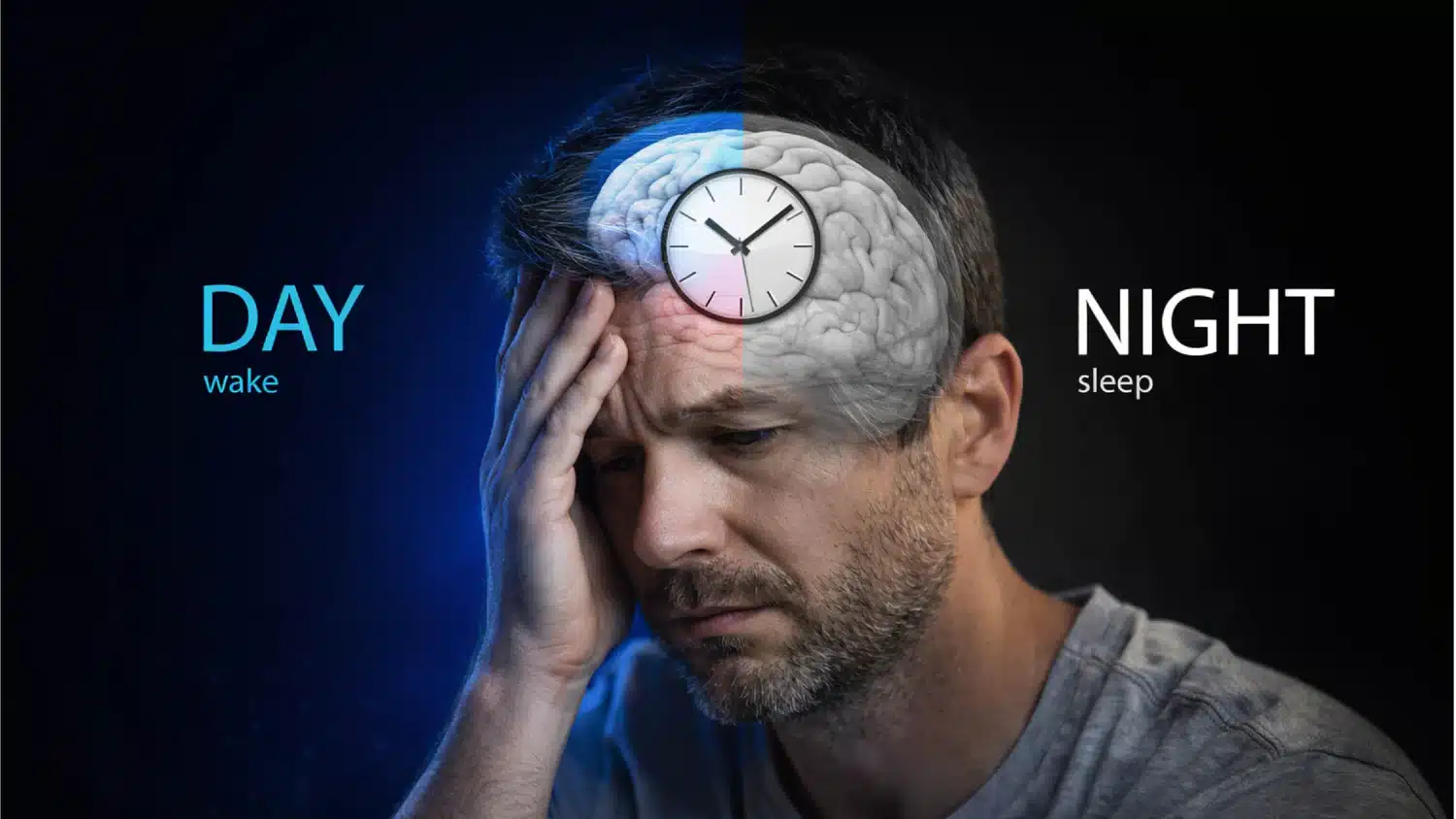
Sleep is not simply a passive period of rest. It is a highly organized physiological process governed by an internal timing network known as the circadian rhythm. When this biological clock becomes misaligned with the outside world, the result is a group of conditions referred to as Circadian Rhythm Sleep Disorders (CRSDs).
As a medical professional who integrates holistic traditions with modern neuroscience, I view these disorders as far more than everyday sleep inconveniences. They are systemic disturbances that can influence metabolic function, hormone balance, and youthful health. This guide is designed as a comprehensive resource for understanding the biology, major subtypes, and evidence-based treatment approaches for CRSDs.
What Are Circadian Rhythm Sleep Disorders?
Circadian Rhythm Sleep Disorders are a category of sleep-wake disorders defined by a chronic or recurring mismatch between the body’s internal circadian timing system and the demands of the outside environment. The word “circadian” comes from the Latin circa, meaning “about,” and dies, meaning “day,” reflecting the roughly 24-hour cycle that governs many of the body’s core physiological processes.
In people living with CRSDs, the timing of sleep and wakefulness is shifted in a way that causes insomnia when they try to sleep and excessive drowsiness when they need to be alert. This mismatch often disrupts social, occupational, and academic functioning, creating a substantial burden in everyday life.
To truly understand CRSDs, it is important to recognize that sleep is governed by two major forces: the homeostatic sleep drive, which builds the longer a person stays awake, and the circadian alerting system. When these two systems are aligned, sleep occurs naturally at night and wakefulness is supported during the day. In CRSDs, however, the circadian pacemaker may be sending wake-promoting signals when the person wants to sleep, or sleep-promoting signals when they need to be functioning.
This misalignment should not be dismissed as merely a matter of poor routine or weak discipline. In many cases, it is strongly rooted in genetic predispositions and neurobiological mechanisms. Whether the cause is an intrinsic malfunction of the biological clock or an external pressure such as shift work, the end result is the same: a persistent inability to sleep and wake at socially expected times.
The Science of the Master Clock
The human body operates much like a finely coordinated orchestra, and its conductor is a tiny brain region called the Suprachiasmatic Nucleus (SCN). Located in the hypothalamus just above the optic chiasm, the SCN receives direct information from the eyes about light and darkness. This master clock coordinates daily cycles in nearly every cell of the body, shaping hormone secretion, temperature regulation, digestion, and more. Understanding the neurobiology of the SCN is essential for understanding how CRSDs arise.
The Suprachiasmatic Nucleus (SCN)
The SCN contains roughly 20,000 neurons that fire in a rhythmic pattern. This neural rhythm is synchronized, or entrained, to the 24-hour solar day mainly through light exposure. Light enters the retina, activates photosensitive ganglion cells, and sends signals directly to the SCN. If the SCN fails to entrain appropriately to these environmental signals, or zeitgebers (time-givers), the body’s internal day can drift away from the actual 24-hour day.
The Role of Melatonin
Melatonin is often called the “hormone of darkness.” It is produced by the pineal gland under SCN control and typically begins to rise in the evening as light levels fall. This nightly increase is a major reason why quality sleep keeps you young, since it supports cellular recovery and repair. In healthy individuals, melatonin levels peak between about 2:00 AM and 4:00 AM. In CRSDs, however, exposure to artificial blue light late at night can suppress melatonin release and delay sleep onset.
Identifying the Signs: Common Symptoms
The clinical picture of CRSDs involves more than simply “feeling tired.” Many patients describe themselves as “tired but wired.” The hallmark complaint is a chronic difficulty falling asleep or waking up that is specifically related to the timing of the sleep period, rather than to an inability to sleep in general.
Fatigue vs. Sleepiness
From a medical standpoint, it is important to distinguish between fatigue and Excessive Daytime Sleepiness (EDS). Patients with CRSDs commonly experience both, often leading to cognitive dysfunction that is frequently described as “brain fog.” This may present as poor concentration, forgetfulness, and reduced mental sharpness, reinforcing why sleep is essential for memory consolidation and cognitive performance.
Physical and Mood Disturbances
Because the circadian clock also regulates digestion and hormonal rhythms, circadian disruption often produces physical symptoms as well. Patients may report gastrointestinal discomfort or metabolic problems, and studies show that poor sleep combined with chronic stress can lead to belly fat. Sleep fragmentation is not always purely neurological either. Conditions such as nocturia, or frequent nighttime urination, can intensify exhaustion in people with CRSDs. There is also a strong two-way relationship between circadian disruption and mood problems such as depression and anxiety.
Overview of Types of Circadian Rhythm Sleep Disorders
CRSDs are generally divided into intrinsic forms, which arise from the body’s internal timing mechanisms, and extrinsic forms, which are driven by external demands or environmental pressures.
Delayed Sleep-Wake Phase Disorder (DSWPD)
This is the most common circadian rhythm disorder, especially among adolescents and young adults. Individuals with DSWPD, often called “night owls,” have a biological clock that runs later than the social norm. They may be unable to fall asleep until 2:00 AM or later and often struggle intensely to wake in time for school or work.
> Delayed Sleep Phase Disorder (DSWPD): The Science Behind Being a “Night Owl”
Advanced Sleep-Wake Phase Disorder (ASWPD)
By contrast, ASWPD represents an extreme “early bird” pattern. Most often seen in older adults, people with ASWPD become sleepy unusually early in the evening, often between 6:00 PM and 8:00 PM, and then wake spontaneously very early in the morning.
> Advanced Sleep Phase Disorder (ASWPD): The Science Behind Extreme Early Birds in Older Adults
Shift Work Sleep Disorder
This extrinsic circadian disorder affects people whose job schedules force them to remain awake when their sleep cycles are biologically programmed for rest. The constant tug-of-war between work demands and the internal clock results in chronic sleep deprivation and insomnia.
Irregular Sleep-Wake Rhythm Disorder
This uncommon disorder is marked by the absence of a clearly structured circadian rhythm. Instead of one consolidated sleep period, sleep breaks apart into at least three short periods spread across the full 24-hour day.
> Jet Lag Disorder: Science-Backed Tips for Crossing Time Zones and Resetting the Clock
Non-24-Hour Sleep-Wake Rhythm Disorder
Most commonly seen in individuals who are totally blind, this condition develops because the SCN does not receive light input strong enough to reset the internal clock. As a result, the person’s internal day may run slightly longer than 24 hours, causing sleep and wake times to drift later each day.
Diagnosis and Management
Diagnosing CRSDs requires a careful clinical history so they can be distinguished from other types of sleep disorders. Diagnosis is rarely made through a single blood test or isolated lab result. Instead, it depends on observing sleep timing patterns over time.
Sleep Logs and Actigraphy
The gold standard for initial assessment is a sleep diary maintained for at least two weeks. This is often paired with actigraphy, a non-invasive tool that uses a wrist-worn device to collect objective data about movement and light exposure.
Light Therapy and Chronotherapy
Treatment focuses primarily on re-entraining the SCN. Bright light therapy involves scheduled exposure to a light box, usually around 10,000 lux, at carefully chosen times to shift the circadian phase. In DSWPD, for example, light is given immediately upon waking to move the internal clock earlier.
> Light Therapy: How to use lightbox therapy to reset your circadian rhythm
Melatonin and Behavioral Changes
Exogenous melatonin may be used as a chronobiotic, meaning a tool to shift circadian timing. Low doses taken several hours before the intended bedtime can help advance the sleep phase. In addition, incorporating natural strategies to reduce nocturia and restore sleep may help reduce physical interruptions that worsen circadian misalignment. Strict sleep hygiene remains essential for stabilizing the circadian system.
> The Role of Melatonin: Timing and Dosage for Rhythm Regulation vs. General Insomnia
Naturem™ Stamina Capsules – Supporting Stamina Under Stress and Hormonal Pressure
Many of the conditions described in this article share a common physiological thread: chronic stress, neuroendocrine imbalance, and depleted vitality. Elevated cortisol, sympathetic nervous system overactivation, and inflammatory signaling do not only affect sexual health. Over time, they undermine stamina, emotional resilience, and physical endurance more broadly.

Naturem™ Stamina Capsules are formulated to support the body during extended periods of physiological strain rather than providing artificial stimulation. Instead of functioning as a quick-fix energizer, the formula is designed to help restore systems-level balance.
Core ingredients such as Rhodiola Rosea and Cuscuta Hygrophilae work together to enhance energy, improve circulation, and help the body handle stress, while Herba Cistanches and Morinda Officinalis are traditionally used to support kidney vitality and libido. Easy to incorporate into daily life, Naturem™ Stamina Capsules provide a safe and supportive way to rebuild energy, endurance, and overall well-being.
As always, consult a healthcare professional before use, especially if you have underlying conditions or are taking medication.
Frequently Asked Questions (FAQ)
Is “night owl” behavior always a disorder?
Not necessarily. Being a “night owl” reflects a chronotype, which is a natural biological variation in sleep timing. It becomes a disorder, such as Delayed Sleep-Wake Phase Disorder (DSWPD), only when it causes significant distress or meaningfully interferes with daily functioning.
Can gut health affect my circadian rhythm?
Yes. The gut contains its own peripheral clock, which interacts with the brain’s central circadian clock. Eating late at night can throw these systems out of sync and contribute to what researchers refer to as metabolic jet lag.
Does the circadian rhythm change with age?
Yes. Teenagers often experience a natural delay in circadian timing, which makes them feel more awake later at night. Older adults, on the other hand, often experience a phase advance, leading to earlier wake times and lighter sleep.
Can blindness cause sleep disorders?
Yes. Light is the primary signal that resets the biological clock. People with total blindness may develop Non-24-Hour Sleep-Wake Rhythm Disorder because their internal rhythm cannot synchronize properly with the external light-dark cycle.
What is “Social Jet Lag”?
Social jet lag occurs when someone follows a strict schedule on workdays but shifts to much later bedtimes and wake times on weekends. This repeated weekly shift creates chronic circadian misalignment, similar to crossing time zones over and over again.
References
- American Academy of Sleep Medicine. (n.d.). Circadian Rhythm Sleep-Wake Disorders. https://aasm.org/clinical-resources/practice-standards/practice-guidelines/circadian-rhythm-sleep-wake-disorders/
- Centers for Disease Control and Prevention. (2022). Sleep Hygiene Tips. https://www.cdc.gov/sleep/about_sleep/sleep_hygiene.html
- FamilyDoctor.org. (n.d.). Melatonin. https://familydoctor.org/condition/melatonin/
- Harvard Health Publishing. (2020). Blue light has a dark side. https://www.health.harvard.edu/staying-healthy/blue-light-has-a-dark-side
- He, S., et al. (2020). Advanced Sleep Phase. StatPearls [Internet]. https://www.ncbi.nlm.nih.gov/books/NBK560737/
- Jones, C. R., et al. (2013). Familial advanced sleep-phase syndrome: A short-period circadian rhythm variant in humans. Nature Medicine. https://www.ncbi.nlm.nih.gov/pmc/articles/PMC4212586/
- National Center for Complementary and Integrative Health. (n.d.). Melatonin: What You Need To Know. https://www.nccih.nih.gov/health/melatonin-what-you-need-to-know
- National Heart, Lung, and Blood Institute. (n.d.). Circadian Rhythm Disorders. https://www.nhlbi.nih.gov/health/circadian-rhythm-disorders
- National Institute for Occupational Safety and Health. (n.d.). Work Schedules: Shift Work and Long Hours. https://www.niosh.cdc.gov/topics/workschedules/health.html
- National Institute of General Medical Sciences. (n.d.). Circadian Rhythms. https://nigms.nih.gov/education/fact-sheets/Pages/circadian-rhythms.aspx
- National Organization for Rare Disorders. (n.d.). Non-24-Hour Sleep-Wake Disorder. https://rarediseases.org/rare-diseases/non-24-hour-sleep-wake-disorder/
- National Library of Medicine. (2019). Neurobiology of the Suprachiasmatic Nucleus. https://www.ncbi.nlm.nih.gov/books/NBK546664/
- Potter, G. D. M., et al. (2016). Circadian Rhythm and Sleep Disruption: Causes, Metabolic Consequences, and Countermeasures. Endocrine Reviews. https://www.ncbi.nlm.nih.gov/pmc/articles/PMC6196960/
- Roenneberg, T., & Merrow, M. (2016). The Circadian Clock and Human Health. Current Biology. https://pubmed.ncbi.nlm.nih.gov/11487661/
- Smith, M. R., et al. (2011). Actigraphy in the assessment of sleep disorders. https://www.ncbi.nlm.nih.gov/pmc/articles/PMC3181774/
- Walker, W. H., et al. (2020). Circadian rhythm disruption and mental health. Translational Psychiatry. https://www.ncbi.nlm.nih.gov/pmc/articles/PMC6335874/
- Zhu, L., & Zee, P. C. (2012). Circadian Rhythm Sleep Disorders. Neurologic Clinics. https://www.ncbi.nlm.nih.gov/pmc/articles/PMC3398006/