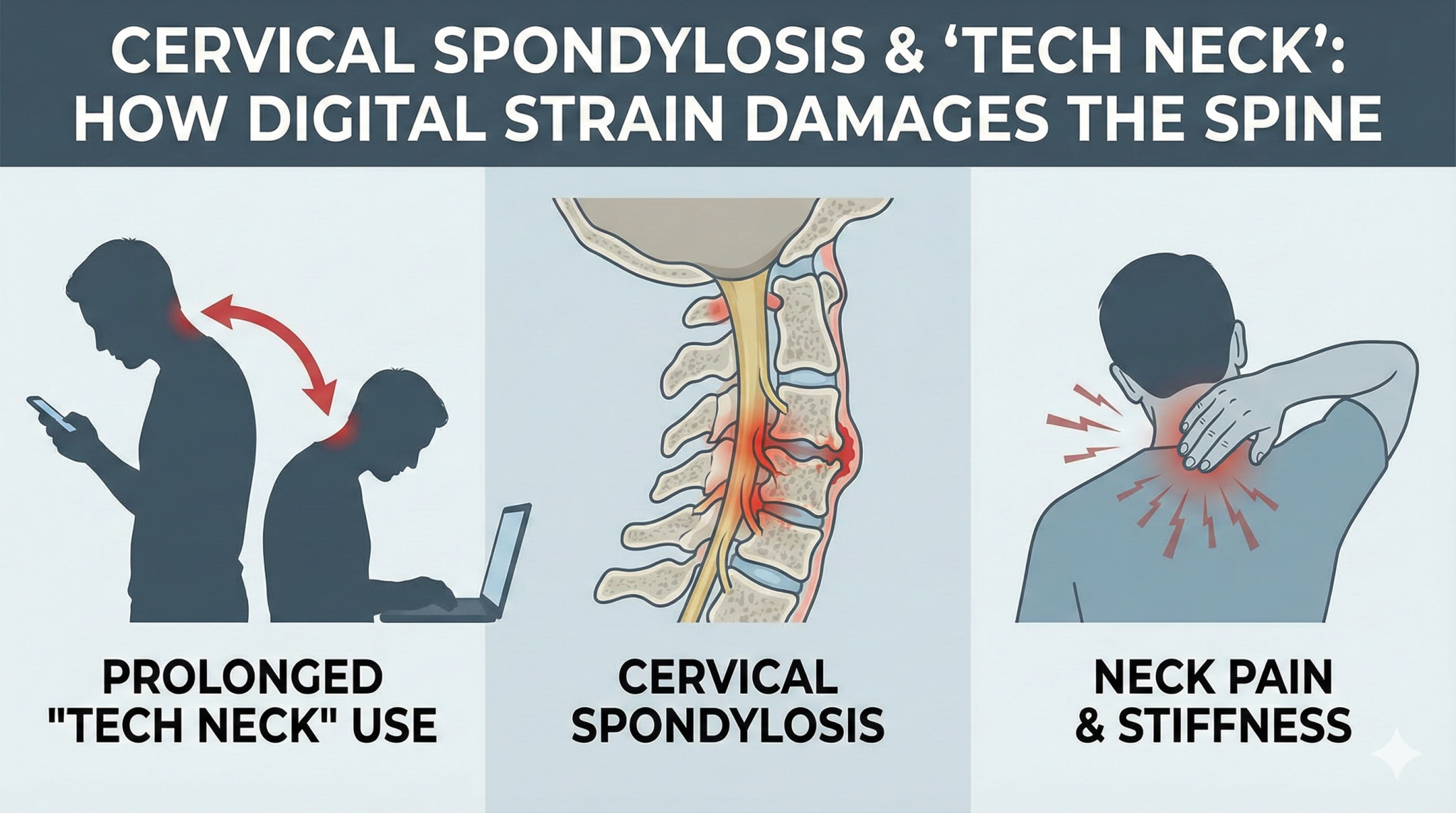
It usually begins innocently enough. You might feel a subtle tightness at the base of your skull after a long day at the office, or perhaps a dull ache in your shoulders after scrolling through your newsfeed in bed. We often dismiss these signals as normal fatigue, the price we pay for living in a connected world. However, these symptoms are often the early warning bells of a condition that medical professionals are seeing at alarming rates: Tech Neck. This modern phenomenon is not just a muscular issue; it is a precursor to a degenerative spine condition known as Cervical Spondylosis.
The Silent Epidemic of the Digital Age
Your neck is an architectural marvel, designed to hold the weight of your head while allowing a vast range of motion. However, it was not designed to hold that weight at a forward angle for eight to ten hours a day. When we stare at our smartphones or hunch over laptops, we are subjecting the delicate structures of the cervical spine to immense pressure. This repetitive stress accelerates the natural aging process of the spine, turning the supple discs and smooth joints of a 30-year-old into the stiff, arthritic spine of an 80-year-old.
The real problem lies in the invisibility of the damage. Unlike a broken bone or a sudden injury, the erosion of your cervical discs happens microscopically, day by day. By the time chronic pain sets in, significant structural changes-such as bone spurs and disc dehydration-may have already occurred. We are facing a future where spinal health issues become the defining occupational hazard of the 21st century.
Learn how natural ingredients can support spinal health and reduce inflammation in our detailed guide on Naturem.us.
The Physics of “Breaking” Your Own Neck
To understand why “Tech Neck” is so destructive, we have to look at the physics of the human body. In a neutral position, with your ears aligned over your shoulders, the average human head weighs between 10 to 12 pounds. Your neck muscles and cervical vertebrae are perfectly evolved to manage this load. However, the moment you tilt your head forward to look at a screen, gravity changes the equation drastically.
Biomechanical studies have shown that for every inch of forward head posture, the weight on the spine increases exponentially. At a 15-degree angle, your head exerts roughly 27 pounds of force. At 30 degrees, it increases to 40 pounds. At 60 degrees-the common angle for texting or browsing social media-your neck is grappling with 60 pounds of force. Imagine carrying an 8-year-old child around your neck for several hours every single day; that is the burden your cervical spine endures.
This massive, sustained load leads to a cascade of physiological failures:
- Disc Dehydration: The intervertebral discs act as shock absorbers. Constant compression squeezes the fluid out of these discs, causing them to flatten and lose their ability to cushion the vertebrae. This is the hallmark of Degenerative Disc Disease.
- Ligament Creep: Over time, the ligaments that hold your spine together become overstretched and lax, destabilizing the neck and forcing muscles to stay in a permanent state of spasm to compensate.
- Nerve Compression: As the discs flatten and the body builds bone spurs (osteophytes) to try and stabilize the spine, the spaces where nerves exit the spinal column narrow. This leads to radiculopathy, characterized by shooting pain, numbness, or weakness traveling down the arm and into the fingers.
If left uncorrected, this doesn’t just result in a stiff neck. It can lead to permanent curvature of the spine (kyphosis), chronic migraines, and in severe cases of myelopathy, compression of the spinal cord itself, affecting your ability to walk or control fine motor skills.
The Medical Mechanism: Understanding Cervical Spondylosis
While “Tech Neck” is the habit, Cervical Spondylosis is the medical result. It is a general term for age-related wear and tear affecting the spinal disks in your neck. As the disks dehydrate and shrink, signs of osteoarthritis develop, including bony projections along the edges of bones (bone spurs).
In Traditional Medicine, we view this as a stagnation of “Qi” (energy) and Blood in the meridian channels traversing the neck and shoulders. When circulation is impeded by poor posture (stasis), the local tissues are deprived of nourishment. In Modern Medicine, this translates to ischemia (reduced blood flow) to the trapezius and levator scapulae muscles, leading to a buildup of lactic acid and inflammatory cytokines.
The intersection of these two worlds-traditional wisdom and modern pathology-reveals that to treat the condition, we must not only mechanically align the spine but also chemically resolve the chronic inflammation that is eating away at the joints.
Explore traditional Vietnamese herbal remedies for joint stagnation and pain relief at SVK Herbal.
A Holistic Protocol for Recovery
Reversing the effects of Tech Neck and managing Cervical Spondylosis requires a multi-faceted approach. You cannot simply take a pill and expect the structure of your spine to change. You must combine ergonomic discipline, physical rehabilitation, and internal nutritional support.
1. The Ergonomic Reset
You must alter the environment that is causing the injury.
- The Eye-Level Rule: Whether you are using a smartphone or a computer, the top third of the screen must be at eye level. This prevents the chin from dropping to the chest. If you use a laptop, invest in a separate keyboard and a laptop stand.
- Neutral Wrists and Elbows: Your elbows should be at a 90-degree angle, and your wrists should remain neutral. This prevents tension from traveling up the arm into the brachial plexus and the neck.
- The 20-20-20 Rule: To prevent digital eye strain and neck rigidity, every 20 minutes, look at something 20 feet away for 20 seconds. This micro-break allows the ciliary muscles in your eyes and the suboccipital muscles in your neck to reset.
2. Physical Rehabilitation
Movement is medicine for the spine. Synovial fluid, which lubricates your joints, only circulates effectively when you move.
- Chin Tucks: This is the antidote to forward head posture. Pull your chin straight back (like making a double chin) to align your ears over your shoulders. Hold for 5 seconds and repeat 10 times. This strengthens the deep cervical flexors.
- Corner Pec Stretch: Tech neck often involves rounded shoulders. Stand in a corner with your arms on the walls and lean in gently to stretch the chest muscles (pectoralis major), relieving the pull on the neck.
3. Nutritional and Herbal Intervention
As a doctor trained in both disciplines, I cannot stress enough the importance of internal chemistry. You need to reduce systemic inflammation to allow the tissues to heal.
- Turmeric (Curcumin): Known in Ayurveda and Traditional Medicine as a potent anti-inflammatory, Curcumin blocks NF-kB, a molecule that travels into the nuclei of your cells and turns on genes related to inflammation. It is essential for managing the pain of spondylosis without the side effects of NSAIDs.
- Glucosamine and Chondroitin: These are the building blocks of cartilage. Supplementing with these helps maintain the fluid and elasticity within the intervertebral discs, slowing the dehydration process.
- Magnesium: Often called the “relaxation mineral,” magnesium is crucial for nerve transmission and muscle relaxation. A deficiency can lead to increased muscle spasms in the neck and shoulders.
Discover our range of bone and joint health supplements designed to support your active lifestyle at Lanui.vn.
igital world, you need a routine. Consistency is key. Here is a doctor-recommended daily guide to keep your cervical spine healthy.
Morning: Mobilize and Hydrate
- Upon Waking: Before you grab your phone, drink a large glass of water. Your spinal discs rehydrate mostly at night; water is their fuel.
- Gentle Movement: Perform 5 minutes of neck rolls and shoulder shrugs to warm up the synovial fluid.
- Supplementation: Take a high-quality joint support supplement containing Glucosamine or Curcumin with breakfast to lower morning stiffness and inflammation markers.
Mid-Day: The posture Audit
- The Hourly Reset: Set a silent alarm on your phone for every hour. When it goes off, stand up, roll your shoulders back, and perform a “doorway stretch” to open up your chest.
- Ergonomic Check: Ensure your computer monitor is high enough. If you are typing on a phone, hold it up in front of your face rather than looking down. It looks strange, but your spine will thank you.
- Hydration: Continue drinking water. Dehydration exacerbates muscle cramps and disc degeneration.
Evening: Restore and Repair
- Heat Therapy: If your neck feels stiff, apply a warm compress or a heating pad for 15-20 minutes. Heat increases blood flow, which brings oxygen and nutrients to damaged tissues.
- Topical Application: Massage a natural herbal balm into the neck and trapezius muscles. Look for balms containing essential oils like wintergreen or menthol, or traditional Vietnamese herbal infusions that penetrate deep into the muscle belly.
- Recommendation: For authentic, high-quality herbal balms, check the selection at HerbsofVietnam.com.
- The Digital Sunset: Stop using handheld devices 30 to 60 minutes before bed. Not only does this save your neck from strain, but the reduction in blue light exposure helps regulate melatonin, ensuring a deeper sleep where true tissue repair happens.
- Sleep Posture: Use a pillow that supports the natural curve of your neck. Avoid sleeping on your stomach, as this forces your neck into extreme rotation for hours, aggravating cervical facet joints.
Conclusion
Cervical Spondylosis may be an age-related condition, but “Tech Neck” is a lifestyle choice. You have the power to control the rate at which your spine ages. By understanding the mechanics of your body, respecting the weight of your head, and utilizing the best of modern ergonomics and traditional herbal medicine, you can maintain a healthy, pain-free neck well into your later years.
Don’t wait for the numbness to start. Start your prevention protocol today. Your spine is the pillar of your life-treat it with the care it deserves.
Naturem™ Joints+: Nourishing Joint Health from Within
True joint strength begins inside the body, where organs, circulation, and metabolism work together to protect bones and connective tissues. Naturem™ Joints+ combines traditional Vietnamese herbal wisdom with modern nutritional science to restore that harmony. Its natural formula targets the root causes of stiffness and discomfort, helping the body repair cartilage, regulate inflammation, and maintain long-term mobility.
Each capsule delivers a synergistic blend of Collagen Peptides, Drynaria Fortunei, Clinacanthus Nutans, Rhizoma Homalomena, and Tinospora Sinensis. Together, they strengthen bones, enhance circulation, and support the body’s natural healing processes. Designed for daily use, Naturem™ Joints+ helps you move with ease, balance, and confidence, the way your body was meant to.
Frequently Asked Questions
In the early stages (muscular strain), yes, it is fully reversible with posture correction and exercise. However, once structural changes like Cervical Spondylosis (bone spurs or disc degeneration) occur, the condition is permanent. Treatment then focuses on pain management and preventing further deterioration.
Sleeping on your back or your side is best. If sleeping on your back, use a rounded pillow to support the natural curve of your neck. If sleeping on your side, ensure your pillow is thick enough to keep your head aligned with your spine. Avoid sleeping on your stomach.
Follow the 20-20-20 rule: Every 20 minutes, look at something 20 feet away for 20 seconds. Additionally, you should stand up and physically move or stretch at least once every hour.
They can serve as a helpful reminder, but they should not be relied upon exclusively. Relying on a brace can actually weaken your posture muscles over time. It is better to strengthen your own muscles through exercises like chin tucks and rows.
Yes. Supplements like Curcumin (Turmeric), Omega-3 fatty acids, and Glucosamine are highly effective at reducing inflammation and supporting joint health. Always consult with a healthcare provider before starting a new regimen.
References
Daily, J. W., Yang, M., & Park, S. (2016). Efficacy of Turmeric Extracts and Curcumin for Alleviating the Symptoms of Joint Arthritis: A Systematic Review and Meta-Analysis of Randomized Clinical Trials. Journal of Medicinal Food, 19(8), 717–729. https://doi.org/10.1089/jmf.2016.3705
Hansraj, K. K. (2014). Assessment of stresses in the cervical spine caused by posture and position of the head. Surgical Technology International, 25, 277–279. https://pubmed.ncbi.nlm.nih.gov/25393825/
Haghghi, A., et al. (2020). The Effect of Forward Head Posture on Respiratory Muscle Strength in Young Adults. Journal of Physical Therapy Science. https://www.ncbi.nlm.nih.gov/pmc/articles/PMC6348123/
Mayo Clinic. (2023). Cervical Spondylosis. Mayo Clinic. https://www.mayoclinic.org/diseases-conditions/cervical-spondylosis/symptoms-causes/syc-20370849
Toh, S. H., Coenen, P., Howie, E. K., & Straker, L. M. (2017). The associations of mobile touch screen device use with musculoskeletal symptoms and exposures: A systematic review. PLoS ONE, 12(8), e0181220. https://doi.org/10.1371/journal.pone.0181220